
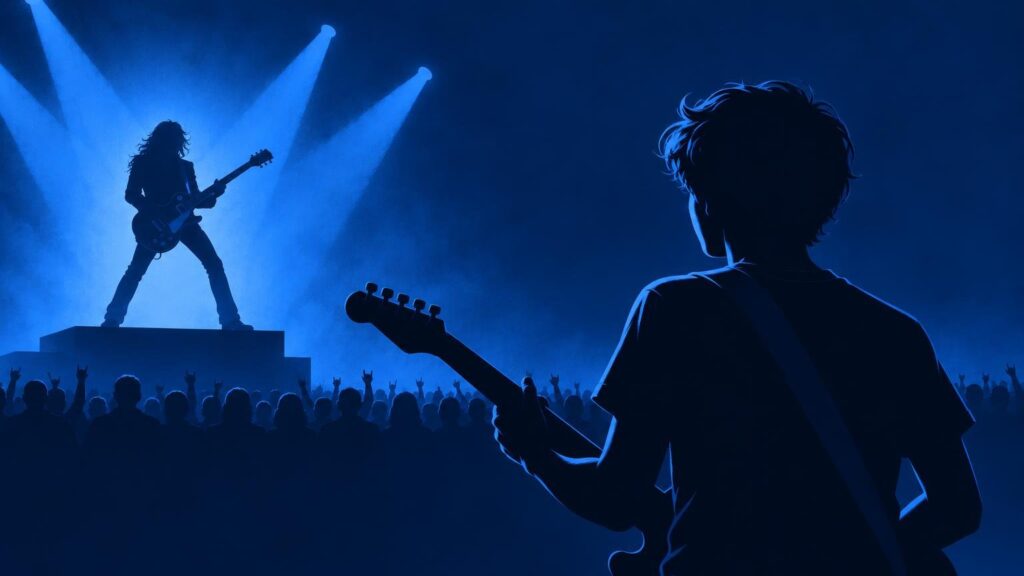
Ace Frehley inspired so many future guitarists because he made the instrument feel both larger than life and within reach. He had the smoking Les Paul, silver makeup, platform boots, and arena-sized attitude, but the musical invitation was surprisingly direct: learn a riff, bend a note, give it vibrato, and make a short solo tell a story.
That combination mattered. Frehley was not merely admired by listeners who later became professional musicians. Tom Morello, Mike McCready, Dimebag Darrell, Rivers Cuomo, Snake Sabo, and John 5 all described him as an early catalyst or major influence. Their own styles diverged wildly, which is exactly the point. Ace did not hand them a rigid technical blueprint. He made them want to play.
TL;DR
Frehley’s influence came from memorable, blues-rooted solos; expressive bends and vibrato; a loose, personality-first attack; and a visual identity that turned guitar playing into an adventure. His parts were exciting enough to inspire obsession but clear enough for a determined beginner to study. Players could enter through Ace and eventually travel anywhere.
He made the guitar look like a doorway
KISS understood that sound and spectacle could reinforce each other. For a young fan, Frehley was not an anonymous session player delivering polished licks. He was the Spaceman, standing on an arena stage with a Les Paul that appeared capable of smoking, flashing, and taking off. The character gave a child something to identify with before that child knew the difference between a major pentatonic phrase and a double-stop.
Snake Sabo called KISS his first rock experience and connected his desire to play with both Frehley and the band’s presentation. That distinction matters: the costume attracted attention, but the guitar provided a way to participate. A fan could not easily build the KISS stage show in a bedroom. A fan could, however, start working out an Ace riff.
The broader theatrical influence should not be confused with direct musical imitation in every case. George Lynch, for example, said Frehley was not a direct influence on his playing while still recognizing the cultural impact of KISS’s image and stage production. Ace’s reach included musicians who copied his solos, musicians who absorbed his attitude, and musicians who simply saw that a guitarist could create an entire identity.
The solos sounded like songs, not exercises
Frehley described his ideal solo as “a song within a song.” That is a useful key to his appeal. The leads in “Cold Gin,” “Shock Me,” and “Rocket Ride” do not feel like technique demonstrations inserted between choruses. They have contours, hooks, pauses, peaks, and recognizable endings. A listener can remember their shape before understanding the mechanics.
This approach gave beginners a realistic first target. The challenge was not simply to play as many notes as possible. It was to make one bend arrive with authority, hold a note without letting it collapse, or repeat a phrase with a slightly different attack. Those are foundational skills, but Ace presented them as rock-star moves rather than homework.
Dimebag Darrell heard that power in “Shock Me.” In a 1992 interview, he called Frehley a major influence and singled out the solo’s vibrato and effect-treated ending. His comments, preserved in a later Guitar World account of Dimebag and Snake Sabo’s admiration, emphasized how Ace could make one note carry enormous weight.
“She” shows how influence travels
Mike McCready offers one of the clearest examples of a Frehley solo becoming part of another generation’s musical language. McCready said he received a guitar in 1978, studied Ace’s solos endlessly, and would not have picked up the instrument without Frehley and KISS. He also identified the solo in “She” as the template for his solo in Pearl Jam’s “Alive.” McCready’s tribute to Frehley documents that direct line from 1970s KISS to one of the defining guitar moments of 1990s rock.
McCready did not become an Ace replica. He carried the dramatic architecture forward: a lead break that builds, sings, and earns its place in the arrangement. That is how durable influence usually works. The student begins by tracing a favorite player’s lines, then absorbs the phrasing deeply enough to use the underlying idea in a new setting.
Ace offered vocabulary without demanding perfection
Frehley identified himself as a blues-based guitarist and named Jimmy Page, Jimi Hendrix, Eric Clapton, Jeff Beck, and Pete Townshend among his formative references. He learned by copying solos and then adapting techniques into his own approach. His recognizable vocabulary included wide bends, expressive vibrato, double-stops, and direct blues-rooted lead phrases.
He also acknowledged that his playing could be loose or “sloppy,” but that looseness was tied to tone and attitude rather than a lack of musical identity. His core recipe was straightforward: a Les Paul through a Marshall, with effects used selectively rather than as a substitute for touch. Phaser, fuzz, echo, octave sounds, pickup-toggle effects, and theatrical guitar modifications expanded the palette, but the hands still had to sell the phrase.
That imperfection may be one reason the early records proved so inviting. The parts have swagger, yet listeners can hear the physical act of playing: the bend being pushed upward, the vibrato widening, and the pick attack giving a repeated note fresh urgency. Ace sounded human enough to follow and distinctive enough to chase.
His influence crossed musical camps
Tom Morello said KISS made him love rock and roll and described Frehley’s impact as formative, adding that Ace’s “DNA imprint” remained in his riffs and solos even though he did not sound like Frehley. Morello’s explanation of Ace as his ultimate guitar hero captures the difference between influence and imitation.
Rivers Cuomo placed Frehley at the beginning of his own chain of guitar influences, before the Scorpions and Yngwie Malmsteen. Cuomo specifically contrasted the blues-based quality of KISS with the more classically oriented harmony he encountered later. Ace was the entry point, not the final destination. Cuomo’s account of that musical progression shows how an accessible first hero can prepare a player for increasingly technical interests.
John 5’s route was equally personal. His official site says Frehley’s instrumental “Fractured Mirror” inspired him to begin playing, and John 5 later used the same title for a composition honoring Ace. The influence reached beyond makeup and hit singles into the atmospheric side of Frehley’s catalog.
The real lesson of Ace Frehley’s influence
Ace’s place in KISS can be compared with the different strengths brought by the band’s later players in our guide to KISS lead guitarists across the major eras. Yet his special historical role remains difficult to duplicate. He arrived at the moment when millions of young listeners were encountering hard rock not only as music, but as a complete world of characters, records, posters, costumes, and guitars.
His greatest gift to future players was permission. A solo could be melodic without being polite, theatrical without losing its blues roots, and technically approachable without sounding small. The first goal was not perfection. It was identity: make the bend speak, make the phrase memorable, and make somebody on the other side of the speakers want a guitar.
That is why testimony from such different musicians keeps returning to the same basic story. They saw Ace, heard Ace, and started imagining themselves as guitarists. His legacy is preserved not only in KISS records or in the memories gathered after his passing, but every time a new player learns that a handful of well-chosen notes can open an entire life in music. Our remembrance of the KISS Spaceman places that continuing legacy in its wider fan context.
References
- Dimebag Darrell and Snake Sabo on their love of Ace Frehley | Guitar World
- GEORGE LYNCH Says ACE FREHLEY Wasn't An Influence On His Guitar Playing: 'And I Feel Bad Saying That' After 'He Just Died' – BLABBERMOUTH.NET
- Ace Frehley on the mystery of his guitar style | Guitar World
- Dimebag Darrell (Pantera) 1992 Interview – The Tapes Archive
- Pearl Jam's Mike McCready Honors Kiss Guitarist Ace Frehley: 'You Changed My Life'
- Ace Frehley and Slash on their love of the Les Paul, British blues-rock, and their unique approaches to the guitar | Guitar World
- Tom Morello on why Ace Frehley is his ultimate guitar hero | Guitar World
- Rivers Cuomo on the Biological Need to Shred, Heavy Metal, and Why Singing Your Solos First Makes For Good Phrasing | GuitarPlayer
- They Will Rock You interviews John 5 ▪︎ JOHN 5 ▪︎ OFFICIAL SITE