
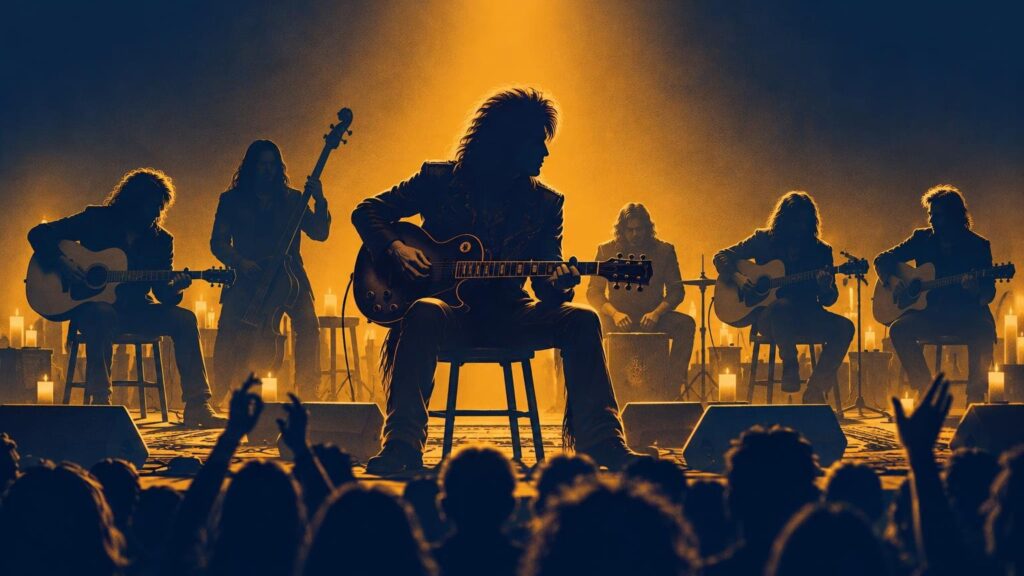
KISS Unplugged did not officially reunite the original band, but it made the reunion imaginable. When Ace Frehley and Peter Criss joined Paul Stanley and Gene Simmons before an audience in August 1995, the moment closed a gap of more than 15 years. It also let fans see the four founders together without makeup, costumes, bombs or hydraulic stage machinery. The songs—and the chemistry between the people playing them—had nowhere to hide.
The crucial detail is that this was not simply the original four reclaiming the stage. The performance began with the working KISS lineup of Stanley, Simmons, Bruce Kulick and Eric Singer. Frehley and Criss entered later, producing an unusual six-member configuration before the founding quartet handled the closing sequence. That distinction matters because Unplugged captured two versions of KISS meeting in public: the accomplished 1995 band and the historically irresistible original lineup.
TLDR: Why KISS Unplugged mattered
KISS taped its MTV Unplugged appearance at Sony Music Studios in New York in August 1995. MTV premiered the special on October 31 at 9 p.m., presenting an acoustic survey of the band’s then-21-year career. Ace Frehley and Peter Criss appeared in the latter part of the program, marking the first audience performance by the four original members in more than 15 years. Contemporary coverage of the MTV premiere documented both the career-spanning concept and the significance of their return.
Roughly eight months later, Stanley, Simmons, Frehley and Criss formally announced a reunion tour aboard the USS Intrepid. Unplugged therefore stands as the clearest public prelude to the reunion, although the chronology alone does not prove that the television session caused it. What the performance unquestionably supplied was visible evidence: the original four could occupy the same stage again, play together and make an audience want more.
KISS arrived prepared for the acoustic format
The reunion image dominates the memory of KISS Unplugged, but the first part of the show deserves more respect than it sometimes receives. Stanley, Simmons, Kulick and Singer did not treat the acoustic format as a novelty or spend the set waiting for the famous guests. They used it to explore corners of the catalog that a standard arena show might have ignored.
The 1996 album includes “Comin’ Home,” “Plaster Caster,” “Goin’ Blind,” “Sure Know Something,” “A World Without Heroes,” “Rock Bottom,” “See You Tonight” and “I Still Love You.” That selection reaches across different KISS identities: hard rock, pop, theatrical balladry and the stranger material that became more interesting with age. It was not merely a greatest-hits set played at reduced volume.
The band also had relevant experience from its 1995 Konvention program, which included an Unplugged portion. The MTV taping was therefore connected to an acoustic approach KISS had already been developing rather than being an abrupt demand to exchange amplifiers for stools.
Bruce Kulick is especially important to the sound of this section. His role was not to imitate Ace or turn every arrangement into a referendum on the original lineup. He played with restraint and supported the songs, while Eric Singer supplied the control needed when large rock arrangements were stripped of their usual impact. The current band made the historical moment possible by establishing a performance strong enough to accommodate it.
Ace Frehley changed the temperature in the room
Then Ace appeared, and the emotional temperature changed. That response was not about technical perfection. It came from identity. Frehley’s guitar phrasing, vocal character and loose physical presence were embedded in the sound and image of 1970s KISS. Even without the silver makeup, he remained instantly recognizable as the Space Ace.
“2,000 Man” was the ideal vehicle for his return. The song originated with the Rolling Stones, but Ace had made it part of his KISS vocabulary by singing the band’s version on Dynasty in 1979. In the Unplugged performance, his lead vocal immediately gave the closing stretch a different personality. It sounded less like a ceremonial guest spot than a familiar character walking back into the story.
The acoustic setting also exposed what made Ace effective. His value was never reducible to speed or complexity. He favored memorable bends, economical blues-rock phrases and notes with enough space around them to register as events. On a loud KISS stage, those qualities could ride above the spectacle. In the Unplugged room, listeners could hear the conversational side of his playing more clearly.
That is why the 1995 footage remains such an effective introduction for newer listeners. Ace does not need a smoking pickup or a wall of amplifiers to establish his identity. The attitude is carried by his timing: slightly behind the beat when the phrase benefits from swagger, direct when a melodic answer needs to land, and rarely crowded with unnecessary detail. Guitar World’s career retrospective on Frehley likewise places the Unplugged session among the defining episodes in his wider story.
Peter Criss completed the emotional argument
If Ace supplied the dangerous grin, Peter Criss brought another kind of recognition. “Beth” had long occupied a unique place in the KISS catalog, and hearing Peter sing it in this setting made the reunion feel personal rather than merely strategic. His presence connected the performance to the vulnerable, eccentric side of the original band—the side that could place a piano-led ballad beside hard rock and somehow make both belong.
On the released album, “2,000 Man” leads directly into “Beth,” followed by “Nothin’ to Lose” and “Rock and Roll All Nite.” Set documentation identifies those four songs as the original-lineup closing sequence, with Frehley and Criss sharing vocal participation on the finale.
That progression is dramatically perfect. Ace gets his individual spotlight. Peter receives his. “Nothin’ to Lose” reconnects the singers to early KISS, and “Rock and Roll All Nite” turns the history lesson into a communal ending. The sequence moves from personality to partnership, then from partnership to the anthem that everyone in the room already owns.
Six musicians, two eras and one unresolved future
The full meaning of the night appears in the six-member stage configuration. Kulick and Singer represented the KISS that had survived changing fashions and rebuilt its live credibility. Frehley and Criss represented the chemistry, imagery and mythology that could not be reproduced simply by playing the same material well.
That creates some tension when the performance is viewed with hindsight. Fans know which lineup would command the next major chapter, but the musicians onstage were not acting out a tidy documentary ending. The original members’ return did not erase the contributions of Kulick and Singer. Instead, the evening demonstrated why KISS history is difficult to compress into one “definitive” lineup: continuity and origin were standing beside each other.
For readers tracing the longer story, the years apart are covered in why Ace Frehley and KISS split. Unplugged is compelling partly because it temporarily suspends that history. Old conflicts were not magically resolved by acoustic guitars, but the shared musical language remained audible.
The album preserved the event without capturing all of it
Mercury released MTV Unplugged on March 12, 1996. The regular U.S. and international CD configuration contains 15 tracks. “Got to Choose” appeared on U.S. vinyl and Japanese CD editions before resurfacing on later releases. The original album and video were selective records rather than complete presentations of everything filmed; set documentation lists additional performances, mistakes and outtakes.
That distinction helps explain why memories of the television special, the album and later expanded footage can blur together. A viewer may remember a song connected to the session without finding it on the standard CD. The released album is best understood as an edited live document with its own pacing, not a minute-by-minute archive of the taping.
As an album, it works because the deep cuts and the reunion material serve each other. The early selections establish that KISS had more musical range than the visual brand sometimes suggested. The original lineup’s appearance then supplies a payoff that feels earned rather than pasted onto a hits package.
Unplugged opened the door, but it did not walk through it alone
It is tempting to write the story as a straight line: Ace and Peter joined KISS on MTV, everybody realized the magic remained, and the reunion happened. The real history should be handled more carefully. The performance preceded the formal announcement by about eight months, making it a prominent public step toward the reunion. That timing does not establish it as the single cause.
What Unplugged did accomplish was enormously valuable. It gave the band and its audience a practical demonstration. The original four could share a stage. Their individual identities remained intact. Fans responded to more than costumes because the musical and emotional cues were still present. The performance also generated images that could circulate far beyond the room: Ace singing “2,000 Man,” Peter returning to “Beth,” and all four founders gathered for the closing songs.
On April 16, 1996, Stanley, Simmons, Frehley and Criss announced the reunion tour aboard the USS Intrepid in New York. Contemporary reporting described it as the first tour by the original four in 15 years. The Alive/Worldwide tour opened at Detroit’s Tiger Stadium on June 28. UPI’s archival report from the reunion announcement captures the scale of the change that followed the quieter MTV stage.
The contrast is pure KISS. Unplugged placed the musicians close together under controlled studio lighting, with the arrangements reduced to their bones. The reunion restored makeup, towering platforms, giant stages and arena-scale spectacle. One event proved that the songs and personalities could survive without the machinery; the next celebrated how thrilling the machinery could be when attached to those personalities again.
Why Ace’s Unplugged appearance still matters
For Ace Frehley fans, the 1995 performance is more than a bridge between two KISS eras. It is a compact demonstration of why his place in the band could never be explained solely by who played which guitar parts. Ace contributed a feel, a voice and an unpredictable human edge. Those qualities became easier to recognize when the production was stripped back.
His return also arrived without an attempt to recreate 1977 visually. There was no Spaceman makeup to tell the audience how to react. The recognition came from the man, the songs and the phrasing. That makes Unplugged one of the clearest arguments for Ace’s musical identity: remove the costume and the character is still audible.
The performance should not be romanticized into proof that every old wound had healed. Nor should it be treated as valuable only because a lucrative reunion followed. It stands on its own as a strong, unusually revealing KISS show—one where deep catalog choices, the capable mid-1990s lineup and the original members all contributed to the result.
The lasting verdict
KISS Unplugged opened the door to the reunion by changing the idea of an original-lineup return from fantasy into something fans could see and hear. It did not settle every business question or erase the years of separation. It did something more immediate: it put Ace Frehley, Peter Criss, Paul Stanley and Gene Simmons together before an audience and let the reaction become part of the historical record.
The essential viewing sequence remains “2,000 Man,” “Beth,” “Nothin’ to Lose” and “Rock and Roll All Nite.” Watch how four distinct personalities gradually become a band in the audience’s mind again. Ace’s entrance supplies the spark, Peter deepens the emotion, and the closing anthem turns possibility into demand. By the time the final chorus arrives, the reunion has not been announced—but the door is unmistakably open.
References
- Kiss Goes Acoustic “kiss Unplugged'' Will Premiere Tonight At 9 On Mtv — Music Television. | Times Leader Archive
- KISS Concert History Online – Discography – "MTV Unplugged" (1996)
- KISS
Convention Schedule
Tentative Program12:
- "I heard someone playing deep, fiery guitar in the room next door. I thought, 'Boy, I wish that guy was in the band!' I looked over the balcony… It was Ace": The otherworldly life and times of Kiss guitar icon Ace Frehley
- KISS Concert Setlist at Sony Studios, New York on August 9, 1995 | setlist.fm
- Kiss members reunite for world tour – UPI Archives