
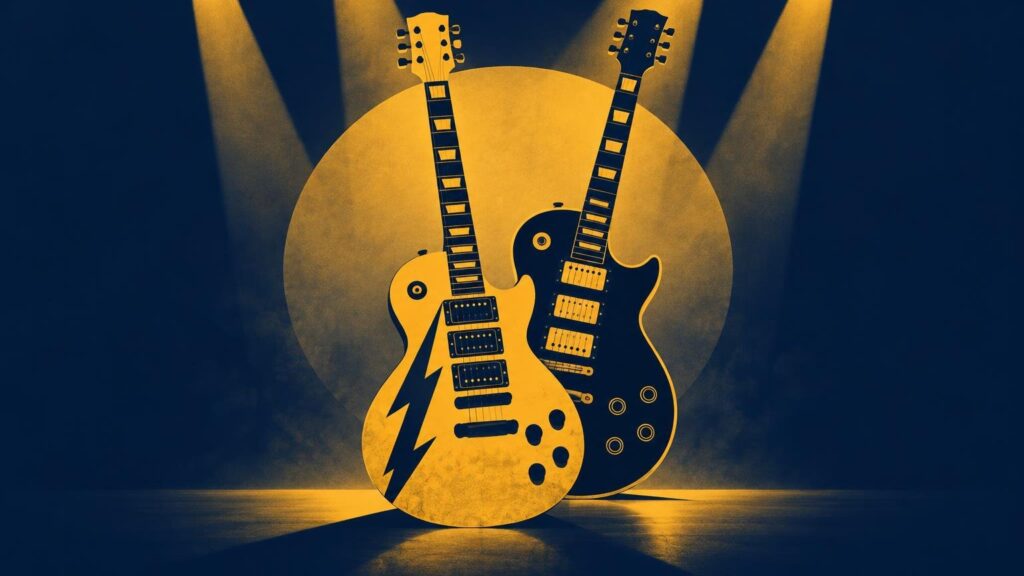
An “Ace Frehley signature Epiphone” can mean one of two very different Les Pauls. The earlier Ace Frehley Signature is the flamboyant model with lightning-bolt fingerboard inlays, three DiMarzio Super Distortion pickups and Ace’s makeup portrait on the headstock. The 2012 Budokan Les Paul Custom is a limited recreation tied to his famous cherry-sunburst stage guitar from KISS’s 1977 Japanese dates. They share the three-pickup Les Paul silhouette, but collectors should not treat them as one continuous model line.
TLDR: Which Ace Epiphone are you looking at?
- Choose the earlier Signature model if you want the unmistakable lightning-bolt look and an all-Super-Distortion pickup configuration built around high-output hard-rock drive.
- Choose the 2012 Budokan if you prefer a more traditional Les Paul Custom appearance, the historically inspired cherry-sunburst design and a mixed DiMarzio pickup set.
- When buying either one, prioritize originality, fret condition and repair history over an optimistic asking price. The pickups, tuners and electronics deserve especially close inspection.
- Do not identify the guitar from its three cream humbuckers alone. Fingerboard inlays, headstock artwork, pickup models and original presentation materials provide stronger evidence.
The lightning-bolt Ace Frehley Signature
Reverb’s model archive dates the earlier Epiphone Ace Frehley Signature Les Paul to 1997–2006, while Blue Book uses 1999–2006. Period Epiphone material confirms that the guitar was available by 2003 and remained in the company’s 2006 catalog. The safest description is therefore a late-1990s-to-mid-2000s model, with the exact opening year depending on the archival source being used.
This Epiphone belonged to a larger signature-guitar family. Gibson identifies its Custom Shop Ace Frehley Les Paul as a 1997 limited run with “ACE” serial numbers, while a Guernsey’s auction catalog distinguishes among a 300-guitar Custom Shop edition, a Gibson USA version made from 1997 through 2001 and the more affordable Epiphone counterpart. That context matters: the Epiphone was not merely a generic Les Paul with an artist’s name added later. It was presented as an accessible version of the period Ace signature concept.
According to Epiphone’s 2003 catalog, the guitar had a mahogany body with a premium flame-maple top, a set maple neck, a rosewood fingerboard, a 24.75-inch scale and chrome hardware. Its defining visual details were the lightning-bolt inlays and Ace’s KISS-makeup portrait on the headstock. Heritage Cherry Sunburst and Trans Blackburst are consistently documented finishes; archival listings also record Silver Sparkle Blueburst, associated in Epiphone-focused documentation with the Japanese domestic market.
Why the three Super Distortions matter
The earlier Epiphone carried three U.S.-made DiMarzio Super Distortion humbuckers, not simply three anonymous cream pickups. DiMarzio describes the ceramic-magnet Super Distortion as a high-output design created to push tube amplifiers into heavy overdrive. That makes the guitar’s intent clear: this was an Ace-style hard-rock machine rather than an attempt to reproduce a low-output late-1950s Les Paul formula. DiMarzio’s Super Distortion specifications document the pickup’s design and output positioning.
That choice also fits Ace’s documented preferences. In a period interview with Vintage Guitar, Frehley recalled beginning to use his three-pickup 1974 cherry-sunburst Les Paul around 1976 and said he preferred DiMarzios in his newer Les Pauls. DiMarzio’s own retrospective reproduces his explanation that the three-pickup layout offered tonal variety while looking right onstage, and that he selected the Super Distortion for its forceful sound.
For a player, the likely attraction is immediate output and a strong push into an overdriven amplifier. Three identical high-output pickups may offer less of the vintage-style contrast some players expect between neck and bridge positions, but the guitar’s mission was never subtle archaeology. It translates the visual and electrical ingredients associated with Ace into an Epiphone that looks ready for the opening chord. Amplifier settings, pickup height and the condition of the individual guitar will still shape the result; readers chasing the broader recipe can also explore how Ace Frehley built his Les Paul-and-Marshall guitar tone.
The 2012 Budokan Les Paul Custom
The 2012 Epiphone Ace Frehley “Budokan” Les Paul Custom belongs to a separate historical branch. It references the cherry-sunburst, three-pickup Les Paul Custom associated with KISS’s 1977 Japanese concerts and the Love Gun era. A later MusicRadar account of the original Budokan guitar helps establish why that instrument remains such an important piece of Ace stage history.
Epiphone-focused reference material describes the Budokan as a limited run of 1,000 guitars. Its specifications included a three-piece maple cap over mahogany, a three-piece mahogany SlimTaper neck, an ebony fingerboard with conventional block inlays, a DiMarzio Super Distortion at the bridge and DiMarzio PAF pickups in the middle and neck positions. It was also sold with a case and a group of collectible presentation items.
| Feature | Earlier Signature model | 2012 Budokan |
|---|---|---|
| Primary visual cue | Lightning-bolt inlays and Ace portrait | Block inlays and traditional Custom-style headstock |
| Pickup set | Three DiMarzio Super Distortions | Bridge Super Distortion; middle and neck DiMarzio PAFs |
| Fingerboard | Rosewood | Ebony |
| Historical angle | Accessible version of the late-1990s signature family | Recreation linked to the 1977 Japan-era guitar |
| Collector concern | Verify all three pickups and finish originality | Verify limited-edition package, case and pickup set |
For players, the mixed pickup arrangement is the Budokan’s most meaningful distinction. The bridge retains the high-output Super Distortion associated with Ace’s harder attack, while the PAF-style middle and neck pickups create a more varied specification on paper. That does not guarantee that every surviving example will sound better than the earlier model, but it gives the Budokan a different electrical identity before amplifier, setup and playing style enter the equation.
How to evaluate a used example
There is stronger documentation for factory specifications and period marketing than there is a broad professional-review consensus covering these guitars. Epiphone’s 2006 claim that the earlier model “looks as good as it sounds” is useful as period advertising, not as independent proof that every example has aged equally well. A present-day assessment must concentrate on the actual instrument.
- Identify the model before judging the price. Lightning-bolt inlays indicate the earlier Signature design; block inlays point toward the Budokan specification.
- Confirm the pickup models. On the earlier guitar, three cream humbuckers are not enough—factory documentation calls for three U.S.-made DiMarzio Super Distortions.
- Inspect fret wear, neck relief and the neck joint. A collectible signature on a truss-rod cover does not compensate for an expensive structural problem.
- Check for replaced tuners, altered wiring, enlarged screw holes and repaired headstock damage. Ask for clear photographs beneath the control covers when possible.
- For a Budokan, establish whether the original case and included collectibles remain with the guitar. Their absence may not hurt playability, but it changes the completeness of the package described for the limited edition.
- Request serial-number photographs and a written account of modifications. Provenance should support the physical evidence rather than replace it.
The collector’s verdict
The earlier Ace Frehley Signature is the louder visual statement: lightning bolts, makeup portrait and three Super Distortions make it unmistakably a product of Ace’s larger-than-life guitar mythology. The Budokan is the more focused historical recreation, connecting its specifications and presentation to one of the most recognizable instruments from KISS’s 1977 peak.
Neither is automatically the better purchase. Players should decide whether they want the earlier model’s uniform high-output pickup layout or the Budokan’s mixed DiMarzio set. Collectors should buy the cleanest, best-documented and most original example their budget allows. Above all, identify which Ace Epiphone is actually in front of you—the shared cherry-sunburst, three-pickup outline hides two substantially different guitars.
References
- Epiphone Ace Frehley Signature Les Paul | Reverb
- www.epiphonewiki.org
- C A T A L O G 2 0 0 3
- EPIPHONE Electric Guitar Models
- W1531 Cov Epiphone 3/23/06 12:57 PM Page 3
- Gibson Serial Numbers
- <visual_element id="e1">
- Super Distortion® | DiMarzio
- Paul Stanley and Ace Frehley – Vintage Guitar® magazine
- Remembering Ace | DiMarzio
- "The very guitar Ace played at Kiss's legendary four night residency at Japan's Nippon Budokan arena": Ace Frehley's iconic 'Budokan' Les Paul Custom sells at auction for $512,000