
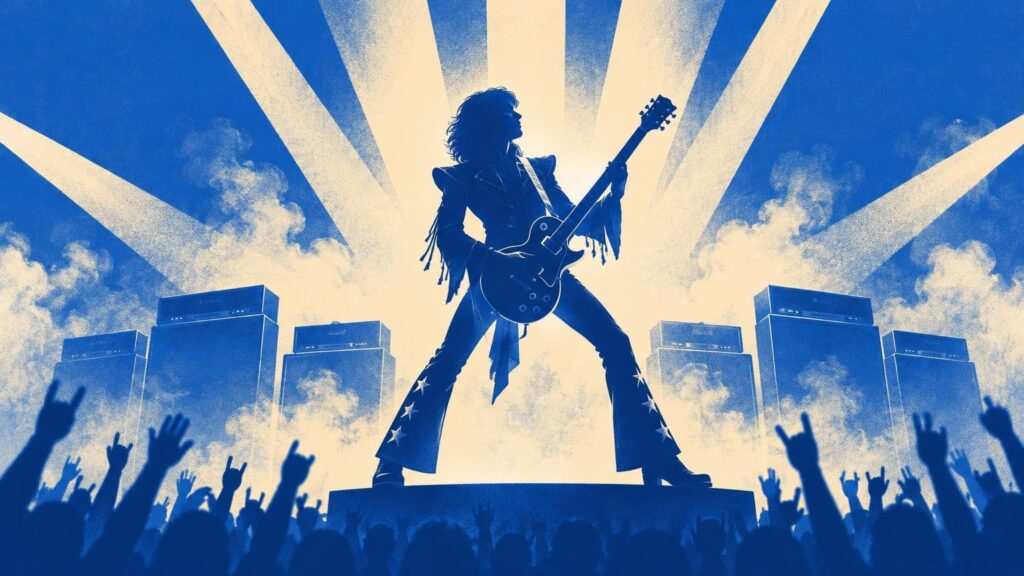
TLDR: The phrase guitar hero concept 1970s describes more than technical lead playing. During the decade, the guitarist became a complete public character defined by recognizable riffs, tone, movement, equipment, costume and stage drama. Ace Frehley is a revealing example because his Les Paul-and-Marshall sound, economical melodic phrasing, controlled feedback and Spaceman image reinforced one another. He did not need to win an objective virtuosity contest; he made the role instantly identifiable.
Long before Guitar Hero became a video game, rock fans already understood the fantasy: strap on a guitar, step into the lights and become someone larger than ordinary life. The first game carrying that title arrived in 2005, making it a later expression of the fantasy rather than its origin. The cultural role itself had been built over decades, and 1970s arena rock gave it an especially powerful visual form.
How the 1970s guitar hero concept worked
The guitar hero was not simply the person assigned to play a solo. It was a role created by several elements working together: a sound listeners could recognize, riffs they could remember, lead phrases that suggested an individual voice, a physical presence onstage and a visual identity strong enough to survive in photographs, posters and the imagination.
A scholarly overview in The Cambridge Companion to the Electric Guitar treats the guitar hero as a classic-rock cultural category and notes the continuing prominence of many 1970s players in later polls. That does not mean the decade invented virtuosity or produced a fixed rulebook. Blues, jazz, country and early rock already had celebrated instrumentalists. What changed was the scale and packaging of the role.
Large rock shows made gestures easier to read when they were bold. A raised guitar neck, a sustained note, a wall of amplifiers or a spotlighted solo could turn an instrumental passage into an event. Album artwork and music magazines then carried that image beyond the venue. The guitarist became both a musician and a repeatable silhouette.
- Sound: a recognizable combination of attack, sustain, distortion and phrasing.
- Songs: riffs and hooks that gave the audience something memorable to carry home.
- Movement: poses and gestures that made playing legible across a large room.
- Equipment: guitars and amplifiers that became part of the player’s public vocabulary.
- Image: clothing, makeup or another visual signature that completed the character.
Not every major guitarist emphasized these elements equally. Some projected mystery, some danger and some painstaking musicianship. Ace Frehley’s version was different again: loose but purposeful, melodic without sounding polished smooth, and wrapped in a science-fiction character that made the lead guitarist seem as though he had arrived from somewhere beyond the stage.
Ace Frehley made the archetype visible
KISS did not ask audiences to separate sound from spectacle. Makeup, costumes, lights and effects formed the environment in which the songs were heard. For Ace, the silver-and-black Spaceman identity did not conceal the guitar playing. It gave that playing a frame.
His posture and phrasing communicated cool rather than frantic effort. He could lean into a riff, leave air between phrases and let a bent note hang against the amplifiers. That restraint matters. A guitar hero needs identifiable musical language, not simply the highest possible number of notes.
This is why reducing Frehley to either “the lead guitarist” or “the guy with the smoking guitar” misses the combination. Period material drawn from Guitar Player’s January 1979 interview addressed both his amplification and the smoking-guitar effect, showing how closely equipment and theatrical presentation were connected in his public identity. Readers interested in the wider staging context can go deeper into how 1970s arena rock turned guitar playing into visual theater.
“Cold Gin,” “Strange Ways” and the physical sound of amplification
Two early KISS tracks help explain the musical side of the character. Frehley associated the original recording of “Cold Gin” with a Les Paul and a 100-watt Marshall JMP Super Lead. That pairing matters less as a shopping list than as a clue to the sound’s behavior. A solidbody guitar pushed through a loud valve amplifier can produce a forceful midrange, sustain and a sensitive relationship between the player’s touch and the speaker output.
“Cold Gin” is a useful guitar-hero song because the central idea is direct. Its riff does not require a technical explanation before it works. The pulse, spaces and descending movement give it a heavy, swaggering identity. Frehley’s contribution is therefore not confined to a designated solo break; the guitar establishes the song’s attitude from the foundation upward.
For “Strange Ways,” Frehley recalled using a Les Paul and Marshall stack and standing in front of the amplifier to seek feedback. Feedback occurs when amplified sound excites the guitar’s strings and pickups, creating a loop that can sustain or reshape a note. In uncontrolled form it can squeal. Used deliberately, it becomes expressive tension.
That recollection captures something central to 1970s guitar heroism: the player was physically interacting with volume. Position relative to the speaker mattered. The note was not merely fretted and sent down a cable; it was allowed to circulate between guitar, amplifier, room and player. For a closer look at how those ingredients fit across his career, see the guide to Ace Frehley’s guitar tone, Les Pauls and Marshalls.
The dramatic image and the practical technique point in the same direction. Frehley’s stage persona suggested dangerous machinery, smoke and outer space, while his playing used loud amplification, sustain and feedback as musical materials. The character felt convincing because the sound supported it.
“Rocket Ride” moved the character toward an individual voice
A band as visually unified as KISS could make each member famous while still placing the group identity first. “Rocket Ride” marked an important step toward a more independent Frehley presence. Written by Ace Frehley and Sean Delaney, it appeared on the studio side of the 1977 album Alive II.
The title alone fits the Spaceman vocabulary, but the record’s importance goes beyond branding. Here was a track that connected Frehley’s writing, guitar identity and vocal presence more directly. It offered a bridge between Ace as one-quarter of the KISS image and Ace as the center of his own record.
That distinction helps clarify what a guitar hero could become. The role might begin with a riff, tone or stage pose, but audiences eventually wanted to hear the world according to that particular player. A recognizable guitarist could develop into a songwriter, singer and standalone recording identity without abandoning the musical traits that first made him distinctive.
The 1978 solo album completed the portrait
The four KISS solo albums were released simultaneously on September 18, 1978. The shared release strategy kept them inside the KISS universe, but the individual records gave each member room to define what his name and face meant away from the usual group configuration.
Ace Frehley’s album should not be described as a completely solitary production. Documented credits associate it with producer and engineer Eddie Kramer, drummer Anton Fig and additional collaborators. Its autonomy came from the strength of Frehley’s identity at the center, not from the false idea that no one else contributed.
“New York Groove” became a crucial part of that identity even though Frehley did not write it. The song was composed by Russ Ballard. That distinction is important because interpretation can be as defining as authorship. In Frehley’s hands, the track connected his Bronx-rooted persona, relaxed vocal delivery and guitar sound to a hook broad enough for listeners beyond the established KISS audience.
The album therefore demonstrates another part of the guitar-hero role: selection. The right song can reveal a performer as clearly as an original composition when the arrangement, voice and attitude make it feel native to that artist. “New York Groove” did not have to be written by Frehley to become inseparable from his solo-era image.
Why Ace fits without an objective ranking
Arguments about guitar heroes often collapse into lists: fastest, most influential, most technically advanced or simply “best.” Those debates can be fun, but they are too narrow for understanding Frehley. His significance is easier to hear and see through recognition.
Play the opening of “Cold Gin,” the heavy atmosphere of “Strange Ways,” the forward motion of “Rocket Ride” and the streetwise hook of “New York Groove.” The details change, but the identity remains coherent. It rests on riffs with room to breathe, melodic lead playing, an audible relationship with loud amplifiers and a persona that never feels detached from the music.
KISS’s theatrical scale strengthened that coherence. The Spaceman makeup supplied a face; the Les Paul supplied a silhouette; smoke and feedback supplied risk; the songs supplied memory. Remove any one element and Ace remains recognizable. Put them together and the complete 1970s guitar hero appears.
The later game borrowed an older fantasy
The Guitar Hero game did not create the cultural idea. Its plastic controller and note highway translated an established rock fantasy into a playable format. The attraction depended on something audiences already understood: the guitarist stands at the point where sound, physical gesture and imagined transformation meet.
Ace Frehley remains a strong guide to that older meaning because he shows that guitar heroism was never only a matter of difficult solos. It was the art of becoming recognizable in a few notes and a single silhouette. To hear the progression, play “Cold Gin,” “Strange Ways,” “Rocket Ride” and “New York Groove” in sequence. Listen for how riff, amplification, voice and character gradually converge. That is the stage revolution the 1970s made impossible to ignore.
References
- From Asteroids to Guitar Hero, World Video Game Hall of Fame finalists draw from 4 decades
- The Guitar Hero in Classic Rock (Chapter 4) – The Cambridge Companion to the Electric Guitar
- Ace Frehley on his Kiss audition | GuitarPlayer
- Ace Frehley reveals his greatest Kiss-era tracks | GuitarPlayer
- KISS Concert History Online – Discography – "Alive II" (1977)
- Ace Frehley on his 1978 Kiss solo LP, its unique “sonics” and liberation from his bandmates
- Ace Frehley, Kiss: Ace Frehley Tracks & Reviews | AllMusic