
TL;DR
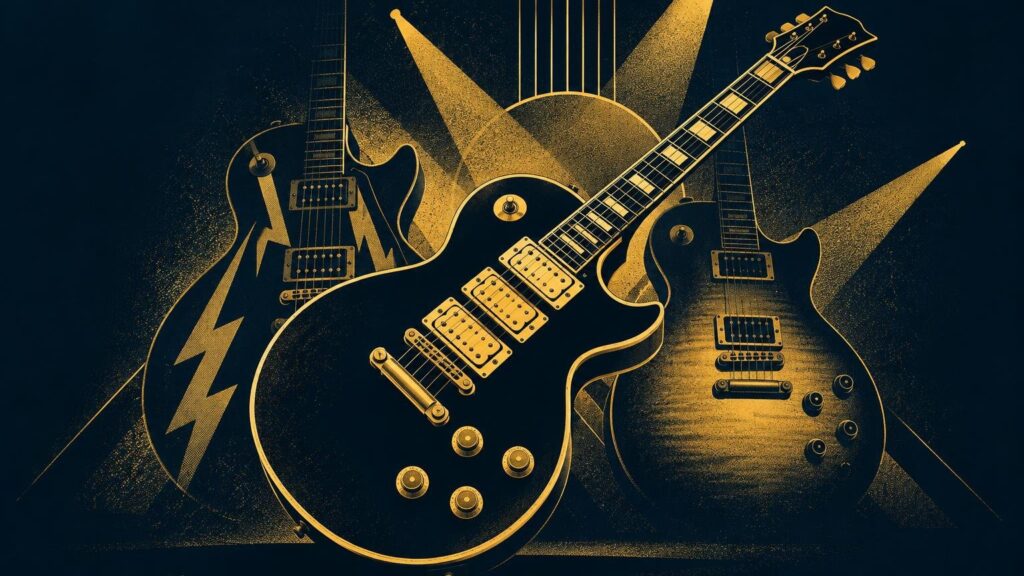
The major Ace Frehley Gibson Les Paul models fall into three families. The late-1990s signature guitars turned Ace’s image into an unmistakable production model with three pickups, lightning-bolt inlays and portrait artwork. The 2012 Budokan releases revisited his famous Cherry Sunburst three-pickup Les Paul Custom, although the Custom Shop and Gibson USA versions differed substantially. The 2015 ’59 Les Paul Standard recreated a former Frehley Burst and presented the quieter, vintage-minded side of his guitar collection.
Together, these guitars explain why the Les Paul became inseparable from Ace’s identity. It supplied the thick bridge-pickup voice he wanted, but it also gave him a large visual canvas for extra pickups, bold inlays, smoking effects and hardware that could be recognized from the back row.
The late-1990s Ace Frehley Signature Les Paul
Gibson’s first major production-era Ace signature design was less a museum copy than a full-volume celebration of the Spaceman. The regular Gibson USA production run is documented from August 1997 through January 2001 and was separate from an earlier 1997 Custom Shop limited edition.
A November 1997 item in Musician magazine’s archive listed the production signature guitar at $5,099. Its specifications included three DiMarzio humbuckers, a figured maple top over a mahogany back, an ebony fingerboard with lightning-bolt inlays and a makeup-era portrait of Frehley on the headstock.
Those details made it an artist model in the loudest and best sense. Three open-coil pickups gave the front of the guitar the crowded, modified look associated with Ace’s stage Les Pauls. Lightning bolts replaced conventional fretboard markers, his signature appeared at the 12th fret, and the headstock portrait completed the visual connection. This was not presented as a strict recreation of one guitar from one KISS concert; it translated Ace’s complete stage character into a Les Paul.
The design also reflected a real preference rather than decorative excess alone. In a 1979 Guitar Player interview later reproduced by DiMarzio, Frehley said he installed DiMarzio pickups in his Gibsons, liked three pickups for tonal variety and appearance, and favored the Super Distortion. For a closer look at how that pickup choice interacted with Marshall amplification and his playing style, see our guide to Ace Frehley’s guitar tone.
The original Budokan guitar became the historical centerpiece
The most historically important Ace Les Paul is the triple-humbucker Cherry Sunburst Custom associated with KISS’s 1977 Nippon Budokan performances. Its exact model year remains disputed: Gibson’s period material described it as a modified 1974 Les Paul Custom, while a later Julien’s-based account identified it as a 1975 Gibson Les Paul. The Budokan connection itself is consistent across the sources.
According to Guitar World’s account of the Julien’s auction history, the guitar was used during the Love Gun sessions in May 1977 and served as Frehley’s principal touring instrument through 1979. It later moved into backup duty, received further modifications after his original KISS run and was eventually restored. In 2026, it sold at Julien’s Music Icons auction for $512,000.
Its importance goes beyond a high auction result. This is the guitar that concentrates the classic Ace formula into one silhouette: a sunburst Les Paul Custom, three cream-colored humbuckers, oversized tuner buttons and the wear of actual arena work. Even without lightning-bolt inlays or a portrait, it reads as an Ace guitar because his identity had already become attached to that configuration.
2012 Custom Shop Budokan: the detailed recreation
During the 2012 NAMM period, Gibson Custom announced the Ace Frehley “Budokan” Les Paul as a recreation of the original stage instrument. Gibson worked with Frehley and the guitar’s owner at the time, Matt Swanson, while directly examining and digitally scanning the original. MusicRadar’s contemporary NAMM report documented the launch.
The Custom Shop run comprised 300 instruments: 50 signed and aged, 100 aged, and 150 VOS guitars. Gibson specified a 1970s-style pancake body, a three-piece mahogany neck, an ebony fingerboard with pearl blocks, a Heritage Cherry Sunburst finish and Grover tuners fitted with pearloid banjo buttons.
Pickup choice and wiring are crucial to understanding this model. The neck and middle positions used DiMarzio PAF-style pickups, while the bridge held a DiMarzio Super Distortion. Gibson also reproduced the original guitar’s unusual electronics, with only the bridge pickup wired through the selector. That makes the extra pickups part of the guitar’s stage appearance more than a conventional three-pickup switching system.
The Gibson USA Budokan was a different guitar
The Budokan name can confuse buyers because Gibson also released a USA production model in 2012. It shared the essential visual idea, but it was not simply a less-aged copy of the Custom Shop instrument.
Contemporary launch specifications describe a weight-relieved mahogany-and-maple build, a Richlite fingerboard with block inlays, chrome hardware, Grover banjo-button tuners and three double-cream DiMarzio Super Distortion pickups. By comparison, the Custom Shop recreation used two PAF-style pickups and one bridge Super Distortion, along with construction and switching intended to follow the original more closely.
The 2015 ’59 Les Paul Standard showed another side of Ace
Gibson Custom’s 2015 Ace Frehley ’59 Les Paul Standard stepped away from the three-pickup Custom format. It recreated a 1959 Burst formerly owned by Frehley, focusing on vintage Les Paul construction rather than his makeup-era stage graphics.
Archived specifications list a figured maple top, one-piece mahogany body and neck, rosewood fingerboard, vintage-style nickel hardware and two CustomBucker Alnico 3 pickups. Promotional and sales material identifies 250 Vintage Gloss instruments plus 50 aged-and-signed guitars, for a stated total of 300.
This model matters because it widens the picture. Ace’s Les Paul identity was never limited to extra pickups and theatrical modifications. He was also drawn to the fundamental Burst recipe: maple, mahogany, two humbuckers and a sunburst finish that lets the figuring become the visual event.
How to identify the major Ace Gibson models
- Late-1990s Signature Les Paul: look for three open-coil pickups, lightning-bolt fingerboard inlays, the 12th-fret signature and Ace portrait headstock art.
- 2012 Custom Shop Budokan: identify the numbered 300-guitar run, ebony fingerboard, period-style construction, mixed DiMarzio pickup set and recreation-oriented wiring.
- 2012 Gibson USA Budokan: look for the Richlite fingerboard, weight-relieved production construction and three Super Distortion pickups.
- 2015 ’59 Les Paul Standard: expect a two-pickup Burst format, rosewood fingerboard, nickel hardware and no overt Spaceman graphics.
Documentation matters because replacement pickups, changed wiring and swapped hardware can blur these distinctions. A seller’s use of “Ace model” or “Budokan” is only the starting point. Serial information, certificates, pickup markings and clear photographs should agree with the specific version being offered.
The lasting Ace Frehley Les Paul identity
Ace’s Gibson signatures succeeded because they captured different truths about the same guitarist. The 1990s model turned his persona into graphic hardware. The Budokan guitars preserved the modified Custom that defined his late-1970s stage image. The ’59 Standard honored his connection to the classic Burst without forcing every familiar Ace symbol onto it.
If one model best expresses the complete visual mythology, it is the three-pickup Cherry Sunburst Budokan Custom. If one best captures the official signature aesthetic, it is the lightning-bolt model from the late 1990s. The ’59 recreation is the connoisseur’s counterpoint—proof that beneath the smoke, makeup and science-fiction spectacle, Ace’s guitar world still began with the enduring shape and sound of a great Les Paul.
References
- GIBSON ACE FREHLEY MODELS electric guitars
- 64
# MUSICIAN — November 1997
## 1. Gibson Ace F
- Remembering Ace | DiMarzio
- ACE FREHLEY “BUDOKAN” LES PAUL CUSTOM
- Ace Frehley's ‘75 Les Paul sells for $512,000 at auction | Guitar World
- NAMM 2012: Gibson Custom releases Ace Frehley 'Budokan' Les Paul | MusicRadar
- Gibson Launch Ace Frehley 'Budokan' Les Paul Custom | Guitar Interactive Magazine
- Gibson Custom Shop Ace Frehley '59 Les Paul Standard VOS Un-signed
- Guitare électrique solidbody de marque Gibson Custom, modèle – Lot 61