
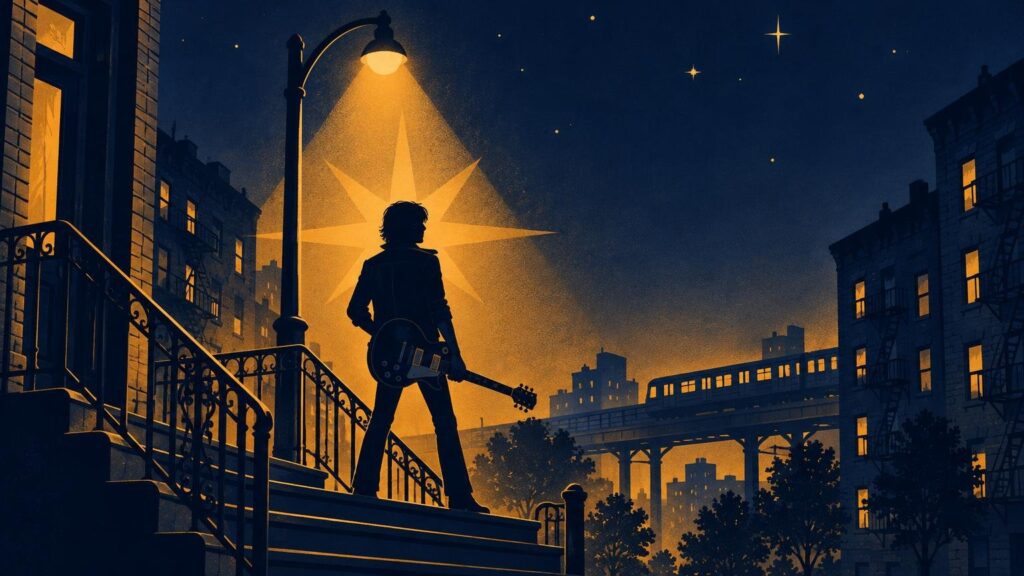
TLDR: Long before Ace Frehley became KISS’s Spaceman, Paul Daniel Frehley was a Bronx kid surrounded by music at home. He learned basic acoustic-guitar chords from his brother, moved on to electric guitar and later remembered weekend gigs as a stronger pull than gang activity. Decades afterward, “Bronx Boy” returned to that history through the emotional filter of a rock song—not as a literal record of every teenage event.
The Ace Frehley Bronx childhood story begins without silver makeup, smoking pickups or a spaceship hovering above an arena. Frehley was born Paul Daniel Frehley in the Bronx on April 27, 1951. The cosmic identity came later; first came a musical household, an acoustic guitar and the realization that playing could offer a place to belong.
That contrast is essential to understanding him. The Spaceman looked as though he had dropped into KISS from another planet, but the guitarist inside the costume carried a distinctly New York combination of humor, toughness and cool understatement. His late-career song “Bronx Boy” made the connection explicit, allowing the man behind the character to look back toward where his musical instincts began.
The Ace Frehley Bronx childhood story started at home
In a 2018 interview, Frehley described growing up in a musically active family. He recalled that his brother showed him basic chords on an acoustic guitar before he eventually received an electric instrument. That sequence matters more than an unsupported list of vintage model numbers: music was already present in the family, someone close to him made the first chords accessible, and electricity turned an initial interest into something with greater possibilities.
For a developing guitarist, the move from acoustic to electric is not merely about volume. An electric guitar invites sustain, distortion, string bends and the physical sensation of an amplifier responding to the player. Those tools would eventually become central to Frehley’s style. His best-known playing favors memorable phrases, vocal-like bends and concise solos that feel composed even when they retain a loose, dangerous edge.
It would be too neat to claim that a particular Bronx block directly created that style. What the recollection does establish is a practical chain: family music led to basic instruction, basic instruction led to an electric guitar, and the electric guitar became a serious focus. The origin story is compelling because it is ordinary in shape. Before the explosions and platform boots, a brother showed a younger brother some chords.
Playing gigs offered a different direction
Frehley’s accounts of adolescence sometimes include gangs and neighborhood trouble, but this part of the story benefits from restraint. In a 2018 Houston Press interview, he recalled that weekend gigs became more important to him than gang activity. That is his retrospective description of a turning point, not permission to reduce either his youth or the Bronx to a rock-and-roll danger story.
The useful detail is the competition for his attention. A gig requires rehearsal, equipment, transportation and enough reliability to appear when other musicians expect you. It also supplies an identity: instead of merely hanging around, the teenager has a band, a set and somewhere to be. By Frehley’s telling, music did not exist as background entertainment. It gave him another route through adolescence.
That route also helps explain why the guitar remained the most convincing part of his public character. Costumes can be designed and stage effects can be engineered, but Frehley’s appeal depended on the feeling that the guitar came naturally to him. The looseness, swagger and flashes of melody sounded less like decoration for the Spaceman image than the engine underneath it.
A careful map of Frehley’s Bronx landmarks
A retrospective ride through Frehley’s old Bronx stomping grounds associated him with Bedford Park, Lebanon Hospital and Poe Park. The account also connected Poe Park with an early outdoor performance. These locations are best understood as reported personal landmarks from a backward-looking tour, not as a complete, independently verified map of every home, school and rehearsal space from his youth.
That distinction does not make the places unimportant. Personal geography is often how musicians organize memory: the park where a band played, the street passed on the way home, or the neighborhood name that still carries a particular attitude. Poe Park is valuable to the story because it brings the scale back down. Before a KISS concert filled an arena, a local outdoor performance represented its own stage and its own audience.
Readers looking for exact addresses, exhaustive school records or a perfectly ordered early-band chronology should be cautious. Frehley told versions of his story across interviews and in the memoir No Regrets, which its publisher lists as released in 2012. Without checked passages and page references, however, the existence of the memoir should not be used to fill gaps with overly precise claims.
“Bronx Boy” turned memory into a song
Released in 2018, “Bronx Boy” gave Frehley a direct way to revisit the teenager who existed before KISS. Guitar World introduced it as a single reflecting on his rough-and-tumble childhood. The song later appeared as track four on Spaceman, which Apple Music dates to October 19, 2018.
The title is revealing in its simplicity. It places local identity ahead of the interstellar character that defined Frehley’s fame. By naming the track “Bronx Boy,” he was not rejecting the Spaceman. He was showing the earthly starting point underneath it.
In Guitar World’s discussion of Spaceman, Frehley said the experience behind the song’s language “definitely hit home.” That supports an autobiographical reading: the material touched memories and feelings he recognized as his own. It does not establish every line as literal reportage or prove that the song’s events occurred exactly as arranged.
Rock songs compress. They combine episodes, sharpen characters and make years of experience fit within a few minutes. “Bronx Boy” is therefore most useful as emotional autobiography. It tells listeners that Frehley still identified with that younger self and considered the Bronx chapter important enough to place near the center of a late-career solo album.
From a local guitarist to the Spaceman
The leap from a Bronx teenager to KISS’s silver-faced lead guitarist is tempting to explain as destiny, but the evidence supports a simpler interpretation. Music entered Frehley’s life through family and guitar. Gigs offered direction. Later, KISS provided a stage large enough for him to transform into the Spaceman, one of rock’s most recognizable visual characters.
The neighborhood did not mechanically cause the persona, and Frehley did not need to erase his local identity to inhabit it. The two sides worked together. The costume supplied fantasy; the playing supplied personality. Behind the science-fiction imagery was a guitarist whose phrasing could be direct, playful and streetwise rather than polished into anonymity.
That tension is part of the lasting fascination. KISS amplified its members into larger-than-life figures, yet Frehley often seemed most appealing when some trace of the Bronx kid showed through: a crooked grin, an unvarnished vocal or a solo that chose one memorable bend over a blur of notes. “Bronx Boy” reversed the usual view. Instead of looking outward from Earth toward the Spaceman, it looked backward from the established star toward Paul Frehley.
Why the childhood story matters to his legacy
Frehley died on October 16, 2025, at age 74. The Associated Press subsequently reported that he died from injuries suffered in a fall and that the medical examiner ruled the death accidental. Readers seeking a broader account can continue with this remembrance of Ace Frehley and the KISS Spaceman.
His death gives “Bronx Boy” added weight, but the song did not need a posthumous frame to matter. It already functioned as a return to origin. Among records built around space imagery, guitar heroics and the mythology surrounding KISS, the track placed a plain neighborhood identity in the foreground.
For fans revisiting Frehley’s catalog, the best next step is to hear “Bronx Boy” alongside the better-known KISS and solo material. Listen for continuity rather than a dramatic dividing line: the teenager drawn toward electric guitar, the musician choosing gigs, the costumed Spaceman and the older artist looking homeward are chapters in the same story.
Frequently asked questions
Was Ace Frehley born in the Bronx?
Yes. Paul Daniel Frehley was born in the Bronx, New York, on April 27, 1951.
How did Ace Frehley begin playing guitar?
Frehley recalled growing up in a musical family and learning basic acoustic-guitar chords from his brother. He later received an electric guitar, which helped move his interest toward the instrument that defined his career.
Is “Bronx Boy” a literal account of his childhood?
It is safest to call it autobiographically connected rather than completely literal. Frehley said the experience behind its language hit home, while Guitar World described the song as a reflection on his childhood. Like most rock songs, it can express genuine memories without documenting every event exactly.
When was “Bronx Boy” released on an album?
“Bronx Boy” appears as the fourth track on Spaceman, released October 19, 2018, according to Apple Music.
The kid remained inside the character
Ace Frehley’s Bronx years should not be treated as a collection of sensational anecdotes or forced into a perfect pre-KISS legend. The documented thread is strong enough: music at home, early help from his brother, an electric guitar, local gigs and an enduring attachment to the identity expressed in “Bronx Boy.” The Spaceman may have appeared otherworldly, but his musical journey began with a family, a neighborhood and a kid learning his first chords.
References
- Ace Frehley, hard-rocking Kiss guitarist, dies at 74 – The Washington Post
- Ace Frehley on Covering Eddie Money
- www.houstonpress.com
- Ace Frehley Gives Us a Ride Around His Old Bronx Stomping Grounds | Kiss Asylum
- No Regrets | Book by Ace Frehley, Joe Layden, John Ostrosky | Official Publisher Page | Simon & Schuster
- Ace Frehley Premieres New Single, "Bronx Boy" | Guitar World
- Spaceman – Album by Ace Frehley – Apple Music
- Ace Frehley Breaks Down His New Album, 'Spaceman' | Guitar World
- Kiss guitarist Ace Frehley died from injuries suffered in fall