
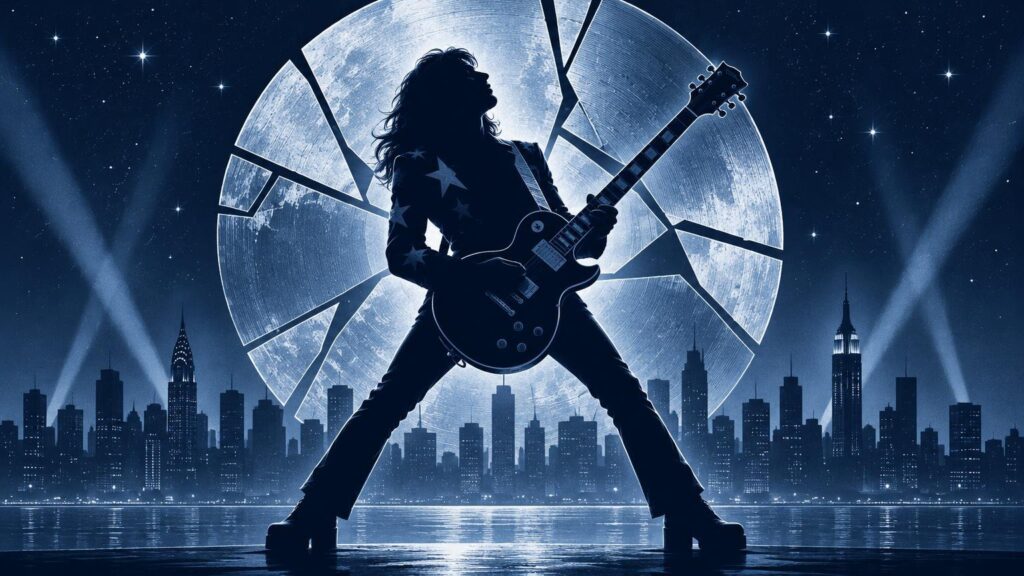
Ace Frehley’s 1978 solo album succeeds because it sounds unmistakably like Ace without reducing him to a collection of familiar KISS guitar moves. It has hard-rock swagger, scruffy humor, melodic instincts, unusual studio textures and just enough vulnerability to make the bravado convincing. “New York Groove” became the hit, but the album’s real strength is the nine-song sequence around it.
Released by Casablanca on September 18, 1978, alongside solo albums by Paul Stanley, Gene Simmons and Peter Criss, Ace Frehley runs for 36 minutes and 44 seconds. It reached No. 26 on the Billboard 200, while “New York Groove” climbed to No. 13 on the Billboard Hot 100. Those numbers only tell part of the story. This was the record that established Ace as more than KISS’s charismatic lead guitarist: he could carry an album, write its strongest material and create a complete sonic world.
TL;DR
Ace Frehley is the most focused and enduring of the four 1978 KISS solo albums. Its appeal goes far beyond “New York Groove”: “Rip It Out” is a ferocious opener, “Snow Blind” and “Ozone” reveal Ace’s taste for strange guitar-synth colors, “Wiped-Out” captures his loose rhythmic personality, and “Fractured Mirror” closes the record with unexpected grace. The production gives his guitars size without polishing away their personality, while the sequencing turns a collection of songs into a statement of independence.
How Ace built his own corner of the KISS universe
The album was recorded during June and July 1978 at the Mansion in Sharon, Connecticut, and Plaza Sound in New York. Frehley and Eddie Kramer received production credit, with Kramer and Rob Freeman engineering. In a retrospective interview with Goldmine, Ace said that KISS needed time apart after years of touring and recording. He also recalled holding back some material around the Love Gun period and choosing what he considered the best nine songs for his solo record.
That sense of pent-up material matters. The album does not sound like a guitarist stretching three ideas across an LP. The riffs, choruses and arrangements arrive quickly, and even the studio experiments serve the songs. Ace also had something to prove. By his account, an offer of assistance from Paul Stanley and Gene Simmons motivated him to finish the project on his own terms.
Ace handled lead and backing vocals plus lead, rhythm, acoustic and bass guitars, as well as guitar synthesizer. Anton Fig played drums and percussion on most of the record, with Carl Tallarico playing drums on “Fractured Mirror.” Will Lee was credited with bass on “Ozone,” “I’m in Need of Love” and “Wiped-Out.” That compact supporting cast gave the album cohesion without making every track feel identical.
The sound: loud guitars, live rooms and careful overdubs
The record’s guitar sound is broad rather than uniform. Ace recalled using Marshall amplifiers alongside a Fender Bassman and Fender Harvard. He said acoustic parts were recorded in the Mansion’s wood-lined library, while amplifiers were sometimes placed in a wooden horse stall to capture its reflections. Later overdubs, including work on “New York Groove,” were completed at Plaza Sound.
Freeman’s account reveals how much engineering sat behind the album’s apparently spontaneous character. Kramer close-miked the drums and used additional microphones on the Mansion’s second floor for ambience. At Plaza Sound, the production accumulated guitar doubles, harmonies, acoustic parts, effects, bell-like guitar sounds and ARP Avatar guitar-synth layers before being mixed manually through an API console. The detailed Rob Freeman interview at KISS Concert History Online is especially valuable for understanding how those textures were assembled.
The result is not slick in the sterile sense. The guitars retain their scrape and punch, Anton Fig’s drums move with the riffs, and Ace’s voice sits naturally inside the arrangements. Kramer and Freeman made the record sound constructed without making it sound confined.
Side one: five originals and no wasted introduction
1. Rip It Out
“Rip It Out” is the correct opening move: immediate, aggressive and compact. Written by Ace Frehley, Larry Kelly and Sue Kelly, it also features Larry Kelly on backing vocals. Ace later included it among the songs he knew were especially strong before the record was completed.
The main riff has the physical, slightly lurching quality that defines Ace at his best. Rather than locking into mechanical precision, the guitars push against the beat, and Fig’s drumming gives the track extra urgency. Ace’s vocal is direct and conversational, while the solo feels like an escalation of the song instead of a detachable guitar showcase.
As an album opener, it announces that the record will not be a cautious side project. Ace is not asking for space within KISS here. He is taking the whole room.
2. Speedin’ Back to My Baby
Credited to Ace and Jeanette Frehley, “Speedin’ Back to My Baby” adds David Lasley and Susan Collins on backing vocals. Its backward guitar solo was made through a tape-transfer and synchronization process, while the automotive effects came from recordings of a Ferrari engine.
The track connects several sides of Ace’s musical identity: a simple rock-and-roll premise, a melodic chorus and a studio trick that never overwhelms the song. The reverse solo sounds disorienting but still follows the track’s emotional motion. It is a clever effect because it feels like speed, distance and reckless momentum rather than technology for its own sake.
3. Snow Blind
“Snow Blind” pulls the record into darker territory. Freeman identified an organ-like ARP Avatar sound behind the solo and a rising synthesizer line around 2:21. Those details expand the atmosphere without turning the track into progressive rock.
The riff is heavy but spacious, leaving room for the vocal and electronic shading. Ace’s slightly detached delivery works especially well here: he sounds caught inside the song rather than positioned above it as an all-knowing narrator. The guitar solo preserves his blues-rock phrasing while the surrounding synth color makes the passage feel stranger and less earthbound.
4. Ozone
“Ozone” is another Frehley original, with Will Lee on bass and ARP Avatar guitar-synth coloration in the arrangement. It is one of the album’s loosest and most revealing performances.
The groove matters more than sheer riff force. Guitar lines drift around the rhythm section, and the vocal approaches the song with a shrug rather than a dramatic declaration. Underneath that casual surface is a carefully layered production. The unusual tones enlarge Ace’s personality instead of disguising it: playful, heavy and a little alien.
5. What’s on Your Mind?
Ace closes side one with his most openhearted pop-rock song on the album. David Lasley and Susan Collins again provide backing vocals. The acoustic texture and bright harmonies give the track a lighter surface, but Ace’s plainspoken vocal keeps it from becoming sugary.
Its placement is crucial. After the heavier atmosphere of “Snow Blind” and the hazy looseness of “Ozone,” “What’s on Your Mind?” clears the air. It also shows that Ace’s writing was not limited to hard riffs and guitar effects. He could build a memorable song from melodic directness, then resist the temptation to overdecorate it.
Side two: the hit, the deep cuts and the perfect finale
6. New York Groove
“New York Groove” was written by Russ Ballard and first recorded by the British glam-rock group Hello in 1975. Ace’s version includes backing vocals from David Lasley and Susan Collins, plus a credited “power mouth” contribution from Bobby McAdams.
Opening side two with the album’s only cover was brilliant sequencing. The stomping beat and clipped guitar pattern create an immediate reset after the more melodic close of side one. Ace does not sing the track as an outsider admiring New York. His Bronx identity makes the refrain feel personal, even though he did not write it.
The arrangement understands restraint. Instead of burying the central hook beneath a wall of lead guitar, Ace lets the rhythm and chant carry the song. That economy helped make it the album’s hit, but it also demonstrates something guitar fans sometimes overlook: one of Ace’s best qualities was knowing when a song needed less guitar.
7. I’m in Need of Love
After the concise impact of “New York Groove,” “I’m in Need of Love” returns the album to a longer Frehley original. Will Lee plays bass. The song’s slow, spacious construction prevents the hit single from dominating everything that follows.
The arrangement breathes. Ace uses repetition to create tension, allowing the groove and layered guitar textures to do more work than the lyric. Where “New York Groove” invites a room to shout along, “I’m in Need of Love” draws the listener back into the album’s private, slightly isolated atmosphere.
8. Wiped-Out
Co-written by Ace and Anton Fig, “Wiped-Out” also features Will Lee on bass. Freeman recalled that Lee was brought in when Frehley and Kramer believed his playing would benefit particular tracks.
“Wiped-Out” is the album at its most unruly. The stop-start momentum, hard accents and playful vocal make it feel like a late-night studio performance that somehow retained all its moving parts. Fig’s co-writing credit makes sense: the drums do not merely accompany the riff but help define the composition’s sharp turns.
Placed near the end, the song provides one final blast of comic-book hard rock before the record changes emotional direction. It is chaotic enough to be exciting but controlled enough to make the transition into “Fractured Mirror” feel dramatic.
9. Fractured Mirror
“Fractured Mirror” is the instrumental that transforms the album from a strong collection of rock songs into a complete statement. Carl Tallarico plays drums, and Bill Scheniman is credited with bell. The original sleeve-derived credits do not list Will Lee on this track, although Freeman later remembered Lee as participating; for a formal personnel account, the original release credit carries greater weight.
Ace described creating the resonant ending with a Marshall stack in a marble bathroom and a double-neck guitar. Freeman recalled that the 12-string neck was retuned so it would resonate sympathetically while Ace played the six-string neck. He also identified the high ARP Avatar arpeggio entering around 2:34.
The technical story is fascinating, but the emotional effect is what lasts. Bell-like guitar figures accumulate over a patient progression, giving the music a reflective quality rarely associated with the louder KISS spectacle. Ace does not conclude with another boast, gag or blazing solo. He ends with texture, melody and unresolved space.
That choice reveals the album’s hidden center. The record is fun, loud and full of attitude, but its final minutes suggest that the Space Ace persona contained more introspection than the makeup and smoking guitar could show.
Why the sequencing works
The original LP structure gives the record much of its power. Side one contains five Frehley originals, moving from the attack of “Rip It Out” through increasingly atmospheric material before ending with the melodic “What’s on Your Mind?” Side two begins with the instantly accessible cover, then moves back into Ace’s stranger and more personal territory before closing with an instrumental.
That means “New York Groove” functions as a doorway, not a conclusion. A weaker sequence might have placed the hit near the end and treated everything after it as cleanup. Here it launches the second act. “I’m in Need of Love” restores the album’s darker atmosphere, “Wiped-Out” supplies the last hard-rock jolt, and “Fractured Mirror” provides the release.
Why the album became so important
Ace later said the album’s reception confirmed his belief that he could be more creatively productive outside KISS’s normal internal process. That interpretation makes the record an important chapter in the longer story of why Ace Frehley and KISS eventually split, but the album deserves to be heard as more than advance evidence of band conflict.
It established the full range of Ace’s musical character. The obvious qualities were present: crunchy riffs, economical solos, humor and streetwise vocals. The surprise was how naturally those elements could coexist with acoustic guitars, reverse tape, room ambience, guitar synthesizer and an extended instrumental finale.
Retrospective assessments have repeatedly placed it at the top of the four KISS solo releases. AllMusic’s album review calls it the “best of the bunch,” while Ultimate Classic Rock has described it as the best-selling entry in the set. Those are retrospective judgments rather than an objective measurement of musical worth, but their persistence reflects how well the record has endured.
The final verdict
Ace Frehley is not important merely because it produced the biggest hit from the 1978 KISS solo campaign. It matters because Ace turned freedom into focus. He selected a tight group of songs, found collaborators who strengthened rather than sanitized his style, and used studio experimentation to deepen the music instead of burying it.
Listen first for the obvious landmarks: the opening impact of “Rip It Out,” the stomp of “New York Groove” and the shimmering close of “Fractured Mirror.” Then go back for the details—the backward solo in “Speedin’ Back to My Baby,” the ARP colors in “Snow Blind” and “Ozone,” the open space in “I’m in Need of Love,” and the rhythmic mischief of “Wiped-Out.” That second listen is where a very good 1978 hard-rock record reveals itself as Ace Frehley’s defining album.
References
- Ace Frehley (album) – Wikipedia
- Ace Frehley on his 1978 Kiss solo LP, its unique “sonics” and liberation from his bandmates
- KISS Concert History Online – Interviews – Rob Freeman
- Ace Frehley, Kiss: Ace Frehley Tracks & Reviews | AllMusic
- How Ace Frehley Set Out to 'Show Those F—ers' on His Solo Debut