
TLDR
The 70s arena rock guitar spectacle was not simply a louder version of the club show. It joined amplified scale, recognizable riffs, a distinctive guitarist and carefully timed visual events. Ace Frehley and KISS became one of its clearest expressions because the Spaceman was simultaneously a lead guitarist, a costumed character and a source of onstage suspense. The effects mattered, but the songs and personas gave those effects a reason to exist.
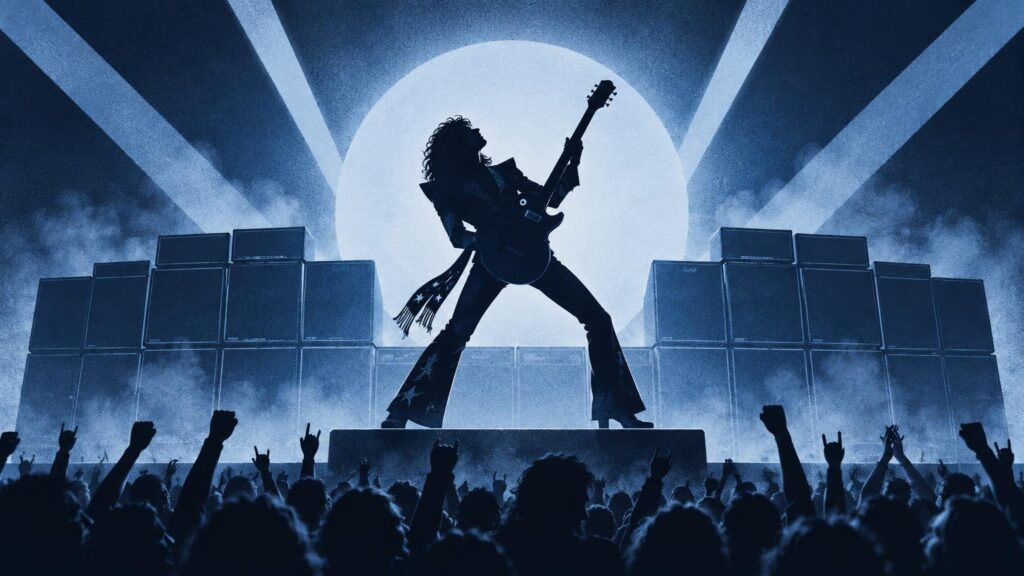
Picture the arena before the first chord: amplifiers stacked into a looming wall, spotlights searching through smoke and a guitarist recognizable from the upper seats by silhouette alone. Once the band starts, a riff becomes more than a sequence of notes. It cues movement, light, audience response and the expectation that something might ignite. That fusion is the heart of 70s arena rock guitar spectacle—and Ace Frehley helped make it look natural.
What made a guitar performance feel arena-sized?
An arena-sized performance did not require the fastest player or the longest solo. It required musical ideas that could survive distance. A strong riff had to register through a large sound system, while the player needed a visual identity legible from the back of the building. The staging then turned familiar musical moments into rituals: the opening stance, the walk toward center stage, the featured solo and the final chord held beneath a burst of light or smoke.
The basic grammar of guitar spectacle included several connected elements:
- Amplified scale: volume and a large backline made the guitar appear physically powerful.
- Riff architecture: clear, repeatable figures gave the crowd an immediate musical signal.
- Player identity: a distinctive costume, posture or instrument made the guitarist recognizable at a distance.
- Visual staging: lights, smoke, movement and effects emphasized selected musical moments.
- Audience ritual: clapping, shouting and anticipation turned the crowd into part of the arrangement.
None of these ingredients worked as well alone. A giant amplifier wall without memorable material was scenery. A brilliant solo without a visible dramatic role could disappear into the size of the room. Arena rock became theater when sound, image and timing pointed in the same direction.
The wall of amplifiers became part of the scenery
Amplifiers had always been practical equipment, but the 1970s rock stage increasingly presented them as architecture. Marshall’s history of the period describes the wall-of-amps phenomenon as a defining rock image and connects KISS’s Alive! breakthrough with that amplifier-centered visual culture. Whether every visible cabinet was essential to the sound is less important here than what the audience saw: electrical power arranged like a fortress behind the band.
That backdrop changed the meaning of the guitarist’s body. Standing in front of a towering backline made the musician appear to command an enormous machine. Frehley’s silver-and-black Spaceman design intensified the illusion. He did not look like a player who had wandered onstage in street clothes; he looked like the designated operator of the guitar machinery.
This is where KISS separated identity from mere decoration. Paul Stanley, Gene Simmons, Peter Criss and Frehley each occupied a distinct visual role. Ace’s role happened to align perfectly with the cultural image of the mysterious lead guitarist: slightly removed from the frontman, economical in his movement and ready to step forward when the arrangement demanded a flash of melodic danger.
Why Alive! is the essential starting point
A studio-only survey cannot fully explain KISS’s place in this story. Alive!, released in September 1975, presented the songs as crowd-facing events rather than isolated recordings. The album drew on performances from multiple concerts held between May and July 1975, so it should not be treated as a recording of one uninterrupted night. That construction does not diminish its historical value. It clarifies the album’s purpose: to concentrate the live identity of KISS into a record listeners could replay at home.
Readers interested in the documented performance sources can explore the concert history behind Alive!. The important point is that the album communicated scale. Crowd noise, stage announcements, heavier pacing and the force of the band made early KISS material feel built for rooms larger than the ones in which some of it originated.
“Parasite” is a useful Ace-centered example. Its descending, blunt-force riff does not need technical explanation to make its point; it sounds physical. The lead guitar adds abrasion and momentum without breaking the song’s shape. On an arena stage, that directness matters. The audience can follow the riff while the guitarist remains free to sell the moment visually.
Alive! also shows why guitar spectacle depended on the whole band. The rhythm section maintains the forward drive, the vocals invite a collective response and Frehley’s guitar supplies color and lift. He is crucial, but he is not acting in isolation. The Spaceman works because he occupies one defined position inside a larger KISS universe.
Ace Frehley made the lead guitarist a visible character
Many guitar heroes projected personality through technique, clothing or physical movement. Frehley went further because KISS gave that personality a narrative form. The makeup and costume told a new listener what kind of presence he represented before he played a note. His guitar parts then completed the character: sharp bends, melodic departures and concise bursts that seemed to arrive from somewhere outside the song’s main frame before dropping cleanly back into it.
The useful word is concise. Arena spectacle is sometimes remembered as endless excess, but Ace’s strongest musical moments often depend on economy. He could make a short phrase feel like an entrance. That left room for the stage picture to breathe and allowed listeners to remember the shape of a lead break rather than merely its duration.
Several songs illuminate different parts of that identity. “Detroit Rock City” turns the full band into a moving machine, with its guitar lines serving momentum and drama. “Shock Me” places Ace’s voice and guitar persona at the center, making the featured guitarist an explicit character in the show. “Rocket Ride” pushes the science-fiction swagger even further. These are editorial listening anchors rather than proof of one fixed formula, but together they reveal how KISS linked song titles, guitar attitude and stage identity.
The result was repeatable theater. Fans did not have to know the precise equipment or understand the mechanics of an effect. They knew that when the Spaceman moved into focus, a particular kind of musical and visual event was about to occur.
The 1977 show escalated the visual language
By 1977, contemporary observers were describing KISS concerts through the vocabulary of controlled chaos. A Sounds report dated September 17 of that year referred to firecrackers, furnaces, Roman candles and an exploding-guitar effect at the performance under review. The period account is valuable because it captures how the production felt to a witness at the time, rather than how later nostalgia reorganized it.
That report should not be stretched into a claim that every KISS concert used an identical sequence or mechanism. What it does establish is that effects-heavy stagecraft had become central enough to dominate a contemporary description. Readers can consult the archived 1977 Sounds account of the KISS show for the period perspective.
For Ace, the guitar effect completed a dramatic circle. The instrument already produced the sound, matched the character and occupied a privileged visual position. Making it appear to smoke or explode turned it into a stage prop without stripping it of its musical function. The guitar remained the source of the riff and solo; it simply acquired a spectacular final act.
The timing was more important than the raw quantity of pyrotechnics. An effect has dramatic weight when an audience has been trained to watch for it. KISS built that anticipation through recurring characters, song roles and gestures. The visual payoff felt like part of the performance’s logic rather than an unrelated interruption.
Jimmy Page showed that guitar spectacle had other languages
KISS did not own the idea of making a guitarist visually commanding, nor did every major 1970s band use the same theatrical vocabulary. Led Zeppelin’s official archive describes the June 19, 1977 San Diego performance in terms that include lasers, smoke and extended performance structures. That suggests a useful contrast rather than a contest.
Jimmy Page’s stage language could make the guitarist appear like an explorer inside a long, unfolding musical passage. The spectacle emerged through duration, improvisational expectation, unusual visual textures and the sense that a song might open into a much larger space. KISS generally offered a more character-driven and tightly cued experience. Ace was one figure in an ensemble whose makeup, costumes, set pieces and effects established an immediately readable world.
Both approaches understood the arena as an instrument. Zeppelin could stretch time until the building seemed suspended inside the performance. KISS could compress drama into a riff, a pose and a burst of fire. Those differences are precisely why “arena rock” works best as a retrospective description of scale and presentation, not as a claim that every major act belonged to one uniform genre.
Why the spectacle still works without the flames
The best test of theatrical rock is to remove the visuals and play the records. “Parasite,” “Detroit Rock City,” “Shock Me” and “Rocket Ride” retain their identities without makeup, smoke or towering cabinets. Their riffs establish motion, their arrangements create entrances and exits, and their guitar parts give Ace a recognizable musical role.
That is why KISS’s contribution cannot be reduced to pyrotechnics. The band connected each effect to a song, a character or an anticipated point in the show. The audience was not merely waiting for an explosion. It was waiting for the Spaceman’s explosion, at the moment when the guitarist and his instrument had earned center stage.
For collectors building a small KISS display, the same principle is worth following: let the music lead. Start with the record, tour program or period photograph, then add restrained labels or custom vinyl decals for a record crate or display case only when they help organize the collection. Avoid applying modern adhesive graphics to valuable original memorabilia, vintage cases or archival paper items.
The lasting lesson of the Spaceman
Ace Frehley did not single-handedly invent arena-rock theater, and KISS was not the only band to discover that a guitarist could become a visual event. Their achievement was integration. Amplification, riffs, costume, character and effects all reinforced one another, making the guitarist’s role understandable from the farthest seat.
The next time you play Alive! or watch period footage, look beyond the obvious flash. Notice when Ace steps forward, how the arrangement creates space for him and how quickly a compact lead phrase changes the stage’s center of gravity. That is the real machinery behind the spectacle. For a wider reflection on what that presence continues to mean to fans, read our remembrance of the KISS Spaceman.