
TLDR
The Bricks & Minifigs LEGO scandal has not been fully decided in court. This article is my opinion based on public reporting, transcripts, videos and the evidence described so far.
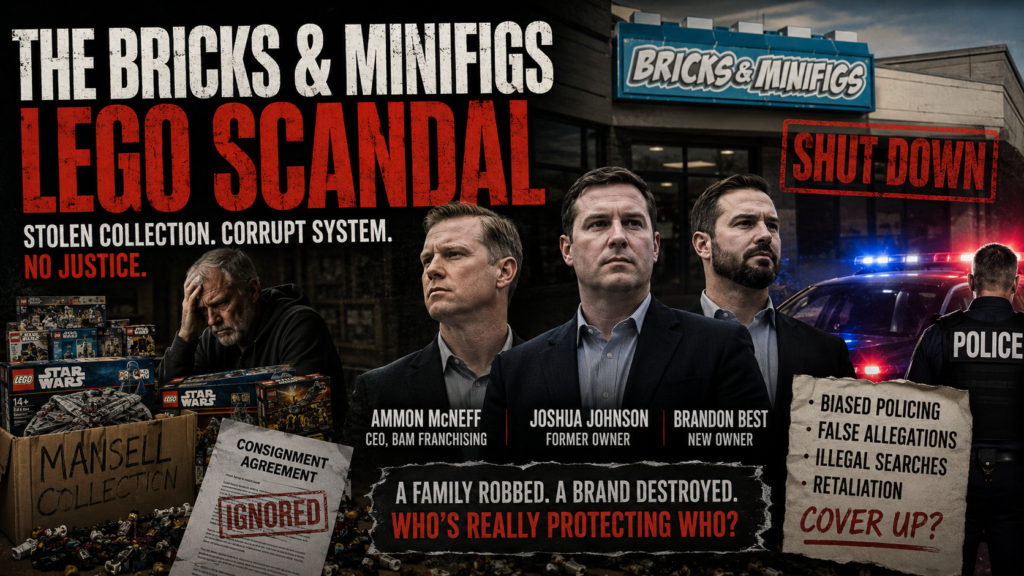
But if the public record is even close to accurate, this story is infuriating. A family allegedly trusted a Bricks & Minifigs store with a valuable Star Wars LEGO collection. The store sold some of it and paid them. Then corporate stepped in, the store changed hands and the family says the remaining collection was not returned or properly paid for.
BAM Franchising looks cowardly. Ammon McNeff’s leadership looks morally bankrupt. Joshua Johnson and Brandon Best look terrible. American Fork police look like they protected the wrong people. And the local LDS/community-power optics look rotten enough that the public deserves real answers.
First, The Court Caveat
The Bricks & Minifigs LEGO scandal has not been fully tested in court. Some facts are disputed. Some claims need documents, testimony, police records, warrant affidavits and cross-examination.
That matters.
But it does not require everyone to act stupid.
The public can look at the reported agreement, the alleged inventory records, the monthly payments, the takeover, the termination letter, the continued-sale allegations, the small-claims defaults, the store closure and the American Fork police response and say the obvious thing:
This whole thing looks rotten.
This article is my opinion. And my opinion is that this scandal is an enraging case study in what happens when people with power appear to treat an ordinary family like disposable collateral.
The legal system can sort out liability.
The moral picture is already ugly.
The Collection Was Not Just “Inventory”
At the center of this scandal is the Mansell family’s Star Wars LEGO collection.
This was not a couple of used sets in a tote. It was reportedly hundreds of sealed Star Wars sets and more than 1,000 minifigs. A serious collection. A family asset. Years of collecting. Money, time and memory stacked into boxes.
That matters because people keep trying to flatten this into a dry franchise dispute.
It is not.
A family allegedly trusted a branded LEGO resale store with something valuable. The store sold some of it and paid them. That proves the relationship was not imaginary. It was functioning. The arrangement was real enough when the store was making money from it.
Then, when things went bad, suddenly everyone found a reason to back away.
That is what makes the story disgusting.
Consignment Is Not A Magic Trick
The collection was reportedly consigned to the Salem-Keizer Bricks & Minifigs store.
Consignment is not hard to understand. The owner keeps ownership. The store gets possession so it can sell the items. The store earns a commission. The owner gets paid when items sell. Unsold items go back to the owner.
That is the basic promise.
So when a business starts acting like possession equals ownership, alarms should go off.
Possession is not ownership. Holding someone’s property does not make it yours. Selling from someone’s collection does not mean you get to keep the rest when corporate drama breaks out.
If a repair shop has your car, the landlord does not own your car because the repair shop gets evicted.
If a dry cleaner has your suit, a creditor does not morally own your suit because the dry cleaner owes money.
And if a Bricks & Minifigs store has someone’s consigned LEGO collection, corporate does not morally own the collection because it seized or transitioned the store.
That is not a complex ethical puzzle. That is kindergarten-level right and wrong.
BAM’s Corporate Response Looks Cowardly
BAM Franchising’s response is the part that should enrage anyone who cares about basic accountability.
The company appears to lean on technical defenses: not our contract, not our authorization, independent franchisee, unauthorized consignment, not corporate responsibility.
Fine. Let the lawyers argue.
But from a leadership standpoint, that is trash.
A franchisor does not get to build national trust, sell franchisees on the value of the brand, benefit from systemwide growth, promote the brand as a trusted resale network, then suddenly pretend it is a stranger when a family says its property disappeared inside that system.
That is the coward’s version of leadership.
BAM wanted the value of the Bricks & Minifigs name when that name helped bring customers through the door. But when the brand became tied to a serious harm, the response appears to have been a retreat into paperwork.
That is not leadership.
That is hiding.
Ammon McNeff Had One Obvious Job
Ammon McNeff, as CEO, had one obvious job: protect the trust that makes the Bricks & Minifigs brand worth anything.
He failed that test.
The ethical move was not complicated. He should have said:
“Someone trusted a Bricks & Minifigs store with a major collection. We dispute parts of the legal responsibility, but we are going to make the family whole first. Then we will sort out liability with the former owners, successor operators, insurers or whoever else needs to be involved.”
That would have been leadership.
Instead, the public sees a CEO and a company trying to define the problem down until nobody with power has to pay.
Not our contract.
Not our approval.
Not our problem.
That may be a legal strategy. It is also morally rancid.
For a franchise system that has publicly talked about hundreds of stores and major systemwide revenue, a $100,000 to $200,000 problem should be a painful check, not a moral identity crisis. A real leader writes the check, protects the family, protects the brand and fights the internal liability battle later.
McNeff’s apparent posture did the opposite. It protected the corporate position while the family remained harmed.
That is why people are furious.
They should be.
“Expressly Prohibited” Looks Like A Rotten Excuse
BAM’s “expressly prohibited” line is one of the ugliest parts of the public defense.
Because if consignment services were allowed under franchise materials, even subject to standards or approval, then “expressly prohibited” is not just a small wording problem. It is a credibility problem.
There is a massive difference between:
“This specific consignment was not approved.”
and:
“Consignments were expressly prohibited.”
The first is a procedural defense.
The second is a sweeping claim meant to make the entire arrangement sound illegitimate from the start.
If the former store owner is right that the agreement did not prohibit consignment, and if franchise materials did reference consignment services as an optional service, then BAM’s public line starts looking like damage control dressed up as policy.
That is the kind of thing that makes people stop trusting anything a company says.
If there is a rule, show the rule.
If the rule does not say what you claimed, stop hiding behind it.
Actual Notice Should Have Ended The Selling
The termination letter should have changed everything.
Once Mansell reportedly demanded return of the unsold property and put the new operators on notice, nobody had a moral excuse to keep treating the collection like ordinary store inventory.
Stop selling.
Freeze everything.
Audit the inventory.
Compare the items against the records.
Return what belongs to the family.
Pay for what was sold or missing.
That is the clean path.
If identifiable Mansell sets were sold after written notice, then the situation stops looking like a confusing transition and starts looking like something much darker.
Before notice, maybe someone can argue confusion.
After notice, the excuses run out.
The decent thing to do was obvious. The fact that the family apparently still was not made whole is what makes this feel so ugly.
Joshua Johnson And Brandon Best Look Awful
Joshua Johnson and Brandon Best are not background characters.
They are central because they are tied to the post-transition operation. The practical questions all point toward the people who controlled the store and inventory after the takeover.
Who had the sets?
Who knew the property was disputed?
Who had the ability to freeze the inventory?
Who could have returned it?
Who allegedly did not?
Who benefited from delay?
Johnson and Best may have defenses. Let them make those defenses in court.
But the public-facing version looks awful. It looks like the kind of evasive, slippery, hide-behind-process conduct that makes people think the whole thing was a scam from the start.
If they had control of disputed property, the moral answer was easy: audit it, return it or pay for it.
Not dodge calls.
Not hide behind police.
Not force people into procedural knots.
Not let the family keep eating the loss.
The Store Closure Looks Like Running
The store closure after the small-claims defaults is brutal.
Maybe there are technical explanations. Maybe there are procedural defenses. Maybe some judgment can be challenged.
But the optics are radioactive.
The public sees this:
A family says its collection was taken or not returned.
Public pressure builds.
Small claims cases are filed.
The defendant does not show up.
Defaults enter.
The store closes.
That looks like running.
It looks like the store avoided a low-cost forum where someone would have to answer questions under oath. And in a story where the central question is “who knew what and who had the sets,” avoiding sworn testimony looks especially bad.
A company that is innocent should want the record cleared.
A company with clean hands should want facts out.
A company that disappears after default judgments looks like it is trying to escape consequences.
That may not be the legal conclusion. But it is the public read. And it is completely understandable.
Reckless Ben Did Not Create The Rot
It is convenient for BAM defenders to make this about Reckless Ben.
His tactics are provocative. Some are legally risky. Some are messy. Some are built for spectacle.
But Ben did not create the underlying scandal.
He did not create the consignment agreement.
He did not create the alleged missing collection.
He did not create the store takeover.
He did not create the decision not to make Mansell whole.
He did not create the need for public pressure.
He showed up because the ordinary process was failing.
And that is the part people should sit with.
A family allegedly had a signed agreement, inventory records, monthly payments, written notice and a massive loss. And still, the system did not move fast enough or cheaply enough to protect them.
So a YouTuber became the tool of last resort.
That should embarrass everyone involved.
The American Fork Police Conduct Looks Corrupt
The American Fork police angle is where the story becomes enraging on a different level.
The transcript does not read like neutral police work. It reads like a department repeatedly stepping in whenever Ben’s group tried to pressure Joshua Johnson.
Trying to talk to Josh? Police.
Trying to serve Josh? Police.
Trying to criticize Josh? Police.
Trying to raise money? Police.
Trying to film or protest? Police.
This is not one questionable call. It is a pattern. And the pattern points in one direction.
The police appear to treat the people pressuring Johnson as the threat, while Johnson appears to get the practical benefit of police protection.
That is why “corruption” is not some wild word here. Corruption does not always mean someone handed an officer an envelope of cash. Sometimes it means the power of the state bends toward local private interests.
That is what this looks like.
The Stop Looks Like A Pretext
The initial traffic stop already smells bad.
Ben’s group reportedly went near Johnson’s house for a good-faith conversation required by the court process. Police appeared before they even reached the door. Then the group was pulled over for an alleged stop sign violation Ben says footage disproved.
The officer also appeared to know who Ben was.
That does not look random.
It looks targeted.
If American Fork police have a clean explanation, they should release it. Because the transcript makes it look like the police were there to stop contact before it happened.
That is not neutral law enforcement.
That is gatekeeping.
The Brandon Best Encounter Looks Like Bias
At Brandon Best’s house, the police response looks even worse.
An officer appears to repeat Brandon’s defense: he inherited the store, he is being blamed for the previous owner’s mess, he is trying to clean things up.
That is not an officer keeping the peace.
That is an officer adopting one side’s story.
In a disputed property case, police have no business acting like Brandon’s unofficial spokesperson. The neutral response would be simple: stay off private property, do not threaten anyone and handle it in court.
But repeating the accused side’s defense on-site? That is bias.
And once police start sounding like one party’s defense team, public trust is gone.
The Heroin Search Is Outrageous If Accurate
The alleged heroin call is the kind of detail that should trigger an outside review by itself.
According to the transcript, police searched the vehicle for drugs and found nothing. No heroin. No drugs. Nothing.
And yet the encounter continued with pressure and warnings.
That is infuriating.
A drug allegation is not a small thing. It gives police a path to detain, search, intimidate and potentially arrest. If that allegation came from someone tied to the dispute, then police should have treated it with extreme caution.
Who made the call?
What exactly did they say?
What evidence supported the search?
Did officers consider that the caller might have a motive to weaponize the police?
Those questions need answers.
Because if a false drug report was used to harass people trying to pursue a civil dispute, that is not just bad policing.
That is the state being used as a club.
Process Service Should Not Become A Police Siege
The process-service section is maddening.
Serving court papers is how civil cases move forward. It is not a crime. It is not harassment by default. It is the legal process.
If Joshua Johnson did not want to be served, too bad. That is not how court works.
You do not get to hide inside, call police over and over, then act like the people serving you are the criminals.
According to the transcript, officers repeatedly acknowledged Ben’s group was not breaking the law. One officer even seemed willing to help deliver the papers. Then the papers came back because Josh did not want them. The court was called. The case was confirmed as real. Then Ben was arrested anyway.
That should make people angry.
Because it looks like police interference with lawful civil process.
It looks like the department was not there to keep the peace. It looks like it was there to make sure Johnson did not have to face the ordinary consequences of being sued.
That is not justice.
That is protection.
The GoFundMe Arrest Is Absurd
The GoFundMe arrest is another level of absurd.
The apparent theory was that saying who the alleged thief is made the speech illegal.
That is not how this works.
Accusing someone of theft can create defamation risk if the statement is false and legally actionable. But it does not automatically become a crime. And it definitely should not turn litigation fundraising into grounds for arrest just because the person being criticized does not like it.
People raise money for legal fights all the time.
They raise money for victims.
They raise money for lawsuits.
They raise money for defense funds.
They raise money because the court system is expensive and ordinary people get buried by the cost.
Arresting someone over a GoFundMe tied to a documented public dispute looks like retaliation. It looks like police power being used to shut down criticism and fundraising.
That should scare people.
Because if police can do that in a LEGO dispute, they can do it anywhere.
The Search Warrant For LEGO Is Almost Too Stupid To Believe
The search warrant for stolen LEGO merchandise is the part that feels like parody.
The entire public controversy is that Mansell’s LEGO collection allegedly disappeared through the Bricks & Minifigs side of the story.
Ben’s group was trying to expose that.
Then police reportedly searched Ben’s residence for stolen LEGO.
That is upside down.
That is the kind of escalation that makes people think the system is not merely confused, but captured.
If police had real probable cause, then show it. Release the affidavit. Explain the evidence. Explain who made the allegation. Explain why that person was credible. Explain whether police disclosed the ongoing civil dispute and the obvious motive for counter-accusations.
Because from the outside, it looks like the accused side made a counterclaim and police ran with it.
That is not how state power should work.
A search warrant is not a toy. It is not a favor. It is not a way to help someone win a public-relations fight.
It is one of the most invasive tools the government has.
Using it in this context looks outrageous.
The LDS/Local Power Optics Are Ugly
The LDS angle needs to be handled carefully.
There is no public proof that the LDS Church as an institution directed police action or coordinated with BAM. That should be stated clearly.
But the local power optics are still ugly.
When the business figures, corporate leadership and local police appear to be tied into the same regional religious and social ecosystem, people will naturally wonder whether informal loyalty is shaping official conduct.
That is not an attack on every Mormon.
That is a concern about local power.
Small communities can protect their own. Church networks, business networks, school networks, police networks and city networks can overlap until nobody has to say the quiet part out loud. Everyone just knows who is “one of us” and who is not.
That is why transparency matters.
If American Fork police were neutral, prove it. Release the records. Explain the stops. Explain the searches. Explain the arrests. Explain the redactions. Explain the warrant.
Because right now, the whole thing looks like a local power structure closing ranks.
And yes, that looks corrupt as hell.
BAM Has Poisoned Its Own Brand
The brand damage here is not accidental.
It is earned.
Bricks & Minifigs is a resale business. That means trust is not a decoration. Trust is the business.
People bring valuable items into these stores. They trade. They sell. They consign. They let strangers handle items that may be worth thousands of dollars.
If customers no longer believe the system will protect them, the brand is in real trouble.
And what has BAM taught customers?
It has taught them that if something goes wrong, corporate may say it was local.
It has taught them that if a franchisee touches your property, corporate may deny responsibility.
It has taught them that if you are harmed, you may be told to sue.
It has taught them that the store may close before you get paid.
It has taught them that the public pressure needed to get attention may result in police attention against the critics.
That is poison.
Not a PR bump. Not a bad week. Poison.
Every Franchisee Now Pays For This
The most unfair part is that unrelated Bricks & Minifigs franchisees now have to carry this stain.
Most of them probably had nothing to do with Salem-Keizer. They did not create this mess. They did not make the corporate decisions. They did not control Johnson, Best or BAM’s public response.
But customers do not experience a franchise system as a pile of separate LLCs.
They see the brand.
That is the whole point of franchising.
So when BAM lets the brand become associated with a family’s missing life savings, every store takes a hit. Every honest operator now has to answer silent questions from customers:
Can I trust this store?
If I sell my collection, will I get paid?
If something goes wrong, will corporate help?
Or will everyone point somewhere else?
That damage is on BAM leadership.
This Was Easy To Fix
That is what makes the whole thing so maddening.
This was easy to fix early.
Not cheap. Easy.
Freeze the inventory.
Hire a neutral auditor.
Compare records.
Return the unsold sets.
Pay for missing or sold sets.
Apologize.
Then sue whoever you think caused the loss.
That is the adult response.
Instead, the public sees denial, distance, disputed policy language, alleged continued sales, defaults, closure, police pressure and a family still not made whole.
That is not a mistake.
That is a chain of choices.
And every choice made the story worse.
The Story So Far
Here is the story in plain English.
A family built a major Star Wars LEGO collection.
They consigned it to a Bricks & Minifigs store.
The store sold some and paid them.
Corporate stepped in.
The store changed hands.
The family says the remaining collection was not returned or properly paid for.
BAM says the consignment was unauthorized and distances itself.
The former owner disputes BAM’s version.
Mansell reportedly demanded return of unsold property.
Identifiable property allegedly kept moving.
Legal help was too expensive.
A YouTuber got involved because the normal system failed.
Small-claims defaults entered.
The store closed.
American Fork police then appeared to repeatedly protect Joshua Johnson from pressure, service and criticism.
A GoFundMe became a police issue.
A search warrant reportedly targeted LEGO at the home of the people exposing the dispute.
And the family still appears not to be made whole.
That is why this story makes the blood boil.
Because the moral answer was obvious from the beginning.
Return the property or pay for it.
The Bottom Line
The Bricks & Minifigs LEGO scandal is infuriating because it exposes every rotten pressure point at once.
Corporate cowardice.
Franchise technicalities.
Local operators dodging accountability.
A family priced out of meaningful justice.
A YouTuber forced into the role of pressure valve.
Police conduct that looks biased, retaliatory and corrupt.
A local power structure that looks like it protects its own.
And at the center of all of it, a family that allegedly trusted the wrong people with something valuable.
BAM Franchising should be ashamed.
Ammon McNeff should be ashamed.
Joshua Johnson and Brandon Best should have to answer cleanly for what happened after the takeover.
American Fork police should face outside review.
And the Bricks & Minifigs brand should stop pretending this is just a misunderstanding or a local issue.
If a family’s collection went into a Bricks & Minifigs store and the family did not get the property or the money, then the moral answer is not complicated.
Make them whole.
Everything else is cowardice.
FAQs
Has The Bricks & Minifigs LEGO Scandal Been Decided In Court?
No. Major issues remain unresolved. This article is opinion based on public reporting, transcripts and evidence described so far.
Why Are People So Angry About The Scandal?
People are angry because the basic moral issue is simple. A family allegedly entrusted a valuable collection to a branded store, then says it did not receive the remaining property or proper payment after a corporate/store transition.
Why Is BAM Franchising Being Criticized?
BAM is being criticized because the dispute happened under the Bricks & Minifigs brand, and corporate appears to have focused on distancing itself rather than making the family whole.
Why Does The American Fork Police Response Look Corrupt?
It looks corrupt because police appear to have repeatedly intervened against the people trying to contact, serve, criticize and raise money against Joshua Johnson while treating Johnson as someone to protect.
Is The LDS Church Proven To Be Involved?
No. There is no public proof that the LDS Church as an institution directed or coordinated the police response. But the local LDS/community-power optics look bad and deserve scrutiny because the police response appears one-sided.
What Should Happen Now?
The family should be made whole. BAM should stop hiding behind technical defenses. American Fork police should face outside review. The full bodycam, dispatch logs, warrant affidavits, arrest reports and redaction decisions should be preserved and examined.
References
Here are the reference links without tracking parameters:
https://www.gofundme.com/f/help-bryan-recover-his-stolen-lego-collection